Part 3 - AI Architecture
Headless AI and the End of the Chatbot-Centric Enterprise
Chat made AI accessible, but agents need capabilities, permissions, events, and business objects. The next enterprise interface is not only a screen. It is intent.
May 16, 2026
Draft essay
The Agentic Practice
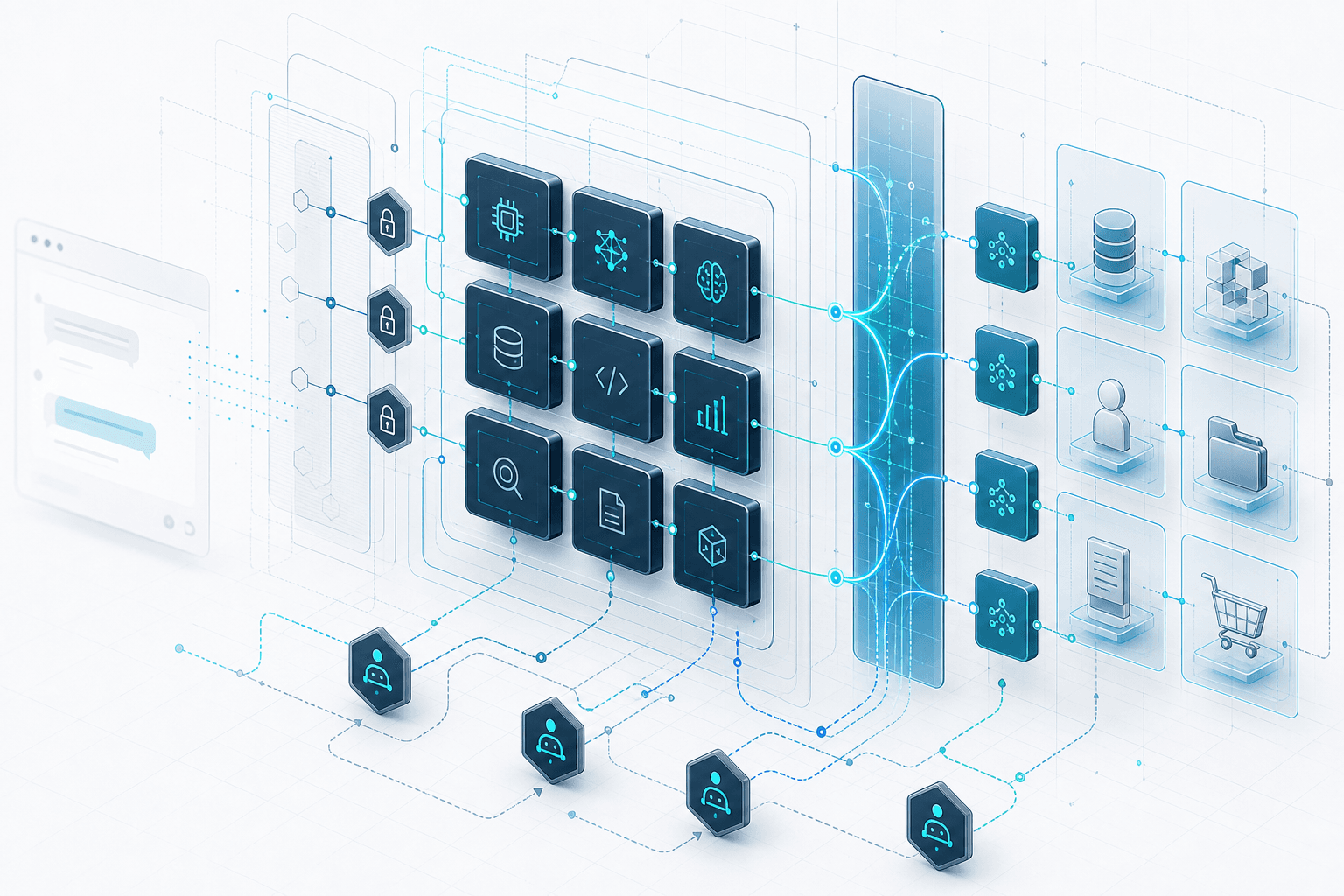
Chat was the first interface, not the final one.
Agents need capabilities, not screens.
Governance becomes part of the interface.
Most enterprise AI is still trapped inside chat interfaces. That made sense for the first phase.
Chat made AI accessible. It gave people a familiar way to ask, explore, summarize, and generate. But chat also created a constraint: every workflow gets squeezed into a conversation.
That is not where enterprise work actually lives.
Chat Was the First Interface, Not the Final One
Real enterprise work happens across systems, events, approvals, tasks, records, campaigns, assets, tickets, workflows, and business objects.
If AI is going to become part of that work, it cannot only live in a sidebar. The next interface is not simply another chat window. It is a way for agents to understand what exists, what can be changed, what requires review, and what action is allowed.
Agents Need Access, Not Screens
Humans use screens. Agents need capabilities.
They need to know what data exists, what actions are available, what permissions apply, what state an object is in, what changed, what can be triggered, what requires approval, and what evidence supports a recommendation.
A screen is optimized for human perception. A capability is optimized for action.
Headless AI Exposes the Business as Capabilities
A headless AI layer exposes business objects, actions, workflows, permissions, context, events, policies, audit trails, tools, and reusable skills.
This is broader than API access. It is about making the business legible to agents in a governed way.
The analogy is headless CMS. Headless CMS separated content from presentation. Headless AI separates intelligence and action from a single interface.
Interactive · Chatbot-centric vs headless
Toggle the architecture.
↓ ↓ ↓ everyone queues here ↓ ↓ ↓
↓ one door ↓
Every consumer — human or agent — funnels through one conversational doorway. Agents wait in line at an interface built for people.
The Agent-Readable Enterprise
A company's internal systems need to become legible to agents. Not by giving agents unrestricted access, but by exposing well-defined interfaces with governance built in.
This matters internally and externally. Internal agents need to operate the business. External agents may increasingly help buyers understand the business.
If context is infrastructure and buyers are agent-mediated, then companies need systems that agents can interact with directly.
Governance Becomes Part of the Interface
Headless AI is not "let agents do anything."
Every capability should expose permissions, allowed actions, review rules, provenance, constraints, logging, rollback, and escalation paths.
Governance cannot sit outside the system as a PDF policy. It has to be part of how capabilities are described and invoked.
The Future Is Multi-Interface
The future is not chat versus UI versus API. It is all of them. Humans may use screens. Executives may use summaries. Operators may use workflows. Developers may use APIs. Agents may use tools. Systems may use events.
The platform has to support all of these without duplicating logic.
Headless AI is not about removing the human interface. It is about accepting that humans are no longer the only users of software.
The companies that understand this will stop treating AI as a chat feature. They will start designing their business systems as agent-readable platforms.
Interactive · Ask this article
Every essay here answers for itself.