Draft - Agentic Marketing
The AI-Era Marketing Org Chart
The old marketing org was built around channels because execution was scarce. AI changes the constraint, so the org chart has to become an intelligent growth system.
July 1, 2026
8 min read
The Agentic Practice
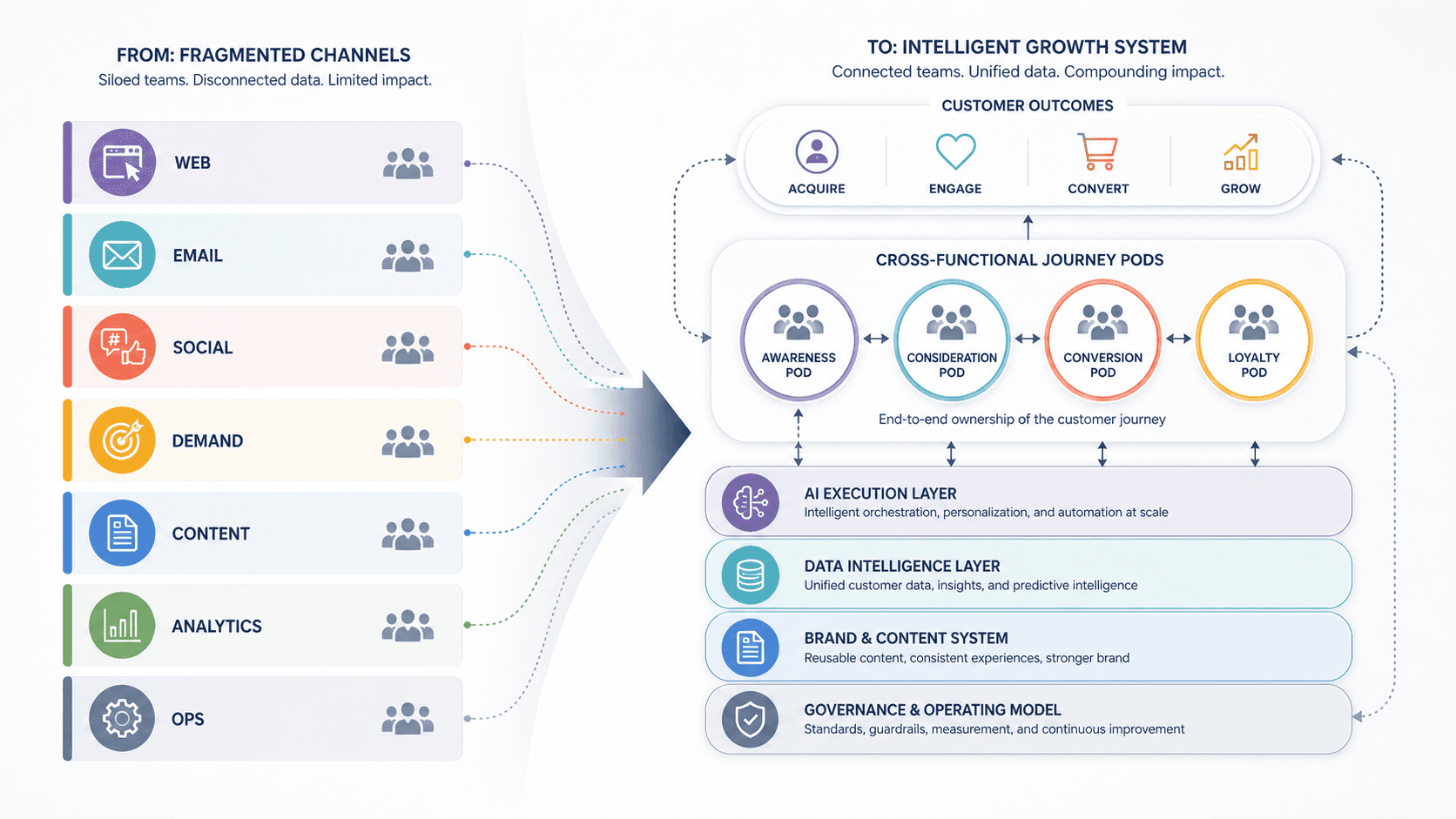
The customer journey becomes the unit of organization.
AI makes production more abundant, so judgment, governance, and orchestration become the scarce work.
Marketing teams should redesign around outcomes, not just make channel teams faster.
For years, marketing organizations were built around channels.
There was a web team. A social team. An email team. A demand generation team. A content team. A marketing operations team. A brand team. An analytics team. Sometimes each team had its own tools, calendars, agencies, metrics, and execution rhythm.
That structure made sense in a world where execution was scarce.
If publishing a web page required a CMS specialist, a developer, a designer, a copywriter, and a campaign manager, then "web ops" naturally became a team. If paid social required platform expertise, media buying, audience setup, creative resizing, and reporting, then social became a team. If email required segmentation, templates, QA, compliance, and deliverability, then email marketing became its own operating lane.
The org chart followed the constraints of the tools.
But AI changes the constraint.
Just as AI is changing software development, marketing is moving from manual production and handoff management toward human-directed systems. McKinsey describes developers shifting from writing every line of code to supervising generation, validating architecture, and managing quality. Marketing is entering the same transition.
The question is not simply: "How do we use AI to make the web team faster?"
The bigger question is: "Do we still need a web team in the same form?"
The Old Org Was Built Around Channels
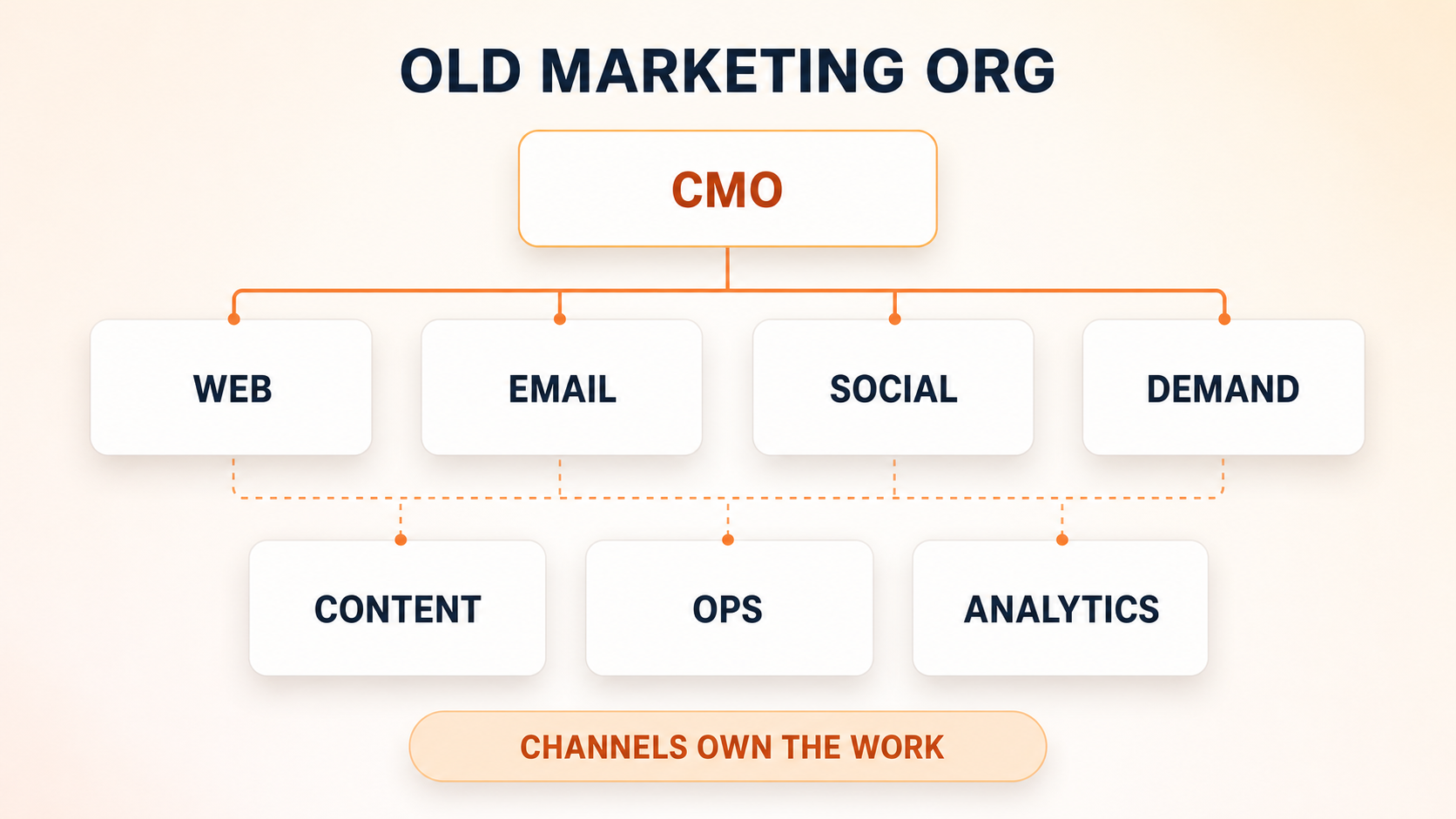
The traditional marketing org often looked like this:
- Chief Marketing Officer
- Brand
- Content
- Web
- Social
- Demand generation
- Field marketing
- Product marketing
- Marketing operations
- Analytics
- Creative
- Agencies
Each function owned a slice of the customer experience. The web team owned the website. Social owned social channels. Email owned nurture. Demand gen owned campaigns. Product marketing owned messaging. Analytics reported performance after the fact.
This created specialization, but it also created fragmentation.
A single campaign might require ten teams to coordinate. A product launch might need separate briefs for web, email, paid media, sales enablement, social, PR, and field. Each channel had its own backlog. Each function optimized for its own output. The customer experienced one brand, but internally the work was split across many operating silos.
AI exposes the weakness of that model.
When AI can generate page variants, adapt copy by audience, suggest campaign journeys, summarize research, assemble creative options, localize content, analyze performance, and recommend next actions, the bottleneck is no longer only production. The bottleneck becomes orchestration, judgment, governance, context, and strategy.
Marketing Becomes Orchestration Work
The first wave of AI in marketing was about productivity: write faster, summarize faster, generate more content, automate repetitive tasks.
That is useful. It is not the transformation.
BCG argues that the deeper opportunity is reinventing the marketing operating model itself. Gartner points to AI agents, AI-powered search and social, data, content, and organizational design as forces reshaping marketing.
The deeper change is this:
Marketing work is moving from humans executing channel tasks to humans directing intelligent systems toward business outcomes.
That means the marketer of the future is less like a channel operator and more like a strategist, editor, systems designer, and performance coach.
Instead of asking:
- Can the web team build this landing page?
- Can social promote this campaign?
- Can email send this nurture?
- Can analytics tell us what happened?
The AI-era marketing team asks:
- What customer outcome are we trying to create?
- What audience context do we have?
- What journey should exist across channels?
- What should AI generate, test, personalize, and optimize?
- What requires human judgment, approval, or brand control?
- What did we learn, and what should change next?
That is a fundamentally different operating model.
The Channel Team Starts to Collapse
This does not mean every specialist disappears. It means the center of gravity shifts.
In the old model, the channel was the unit of organization.
In the new model, the customer journey becomes the unit of organization.
A campaign is no longer "a web page plus an email plus social posts plus ads." It becomes a coordinated growth system made up of audience insight, messaging, offers, content, journeys, experiments, and performance loops.
AI makes this possible because it can help translate intent into execution across many surfaces.
A marketer can define the goal: "Create an ABM motion for these 50 accounts." AI can research the accounts, identify likely pain points, map messages, draft landing pages, generate email variants, suggest paid audiences, create sales enablement, and monitor performance. Humans then guide, approve, correct, prioritize, and refine.
The org chart changes because the workflow changes.
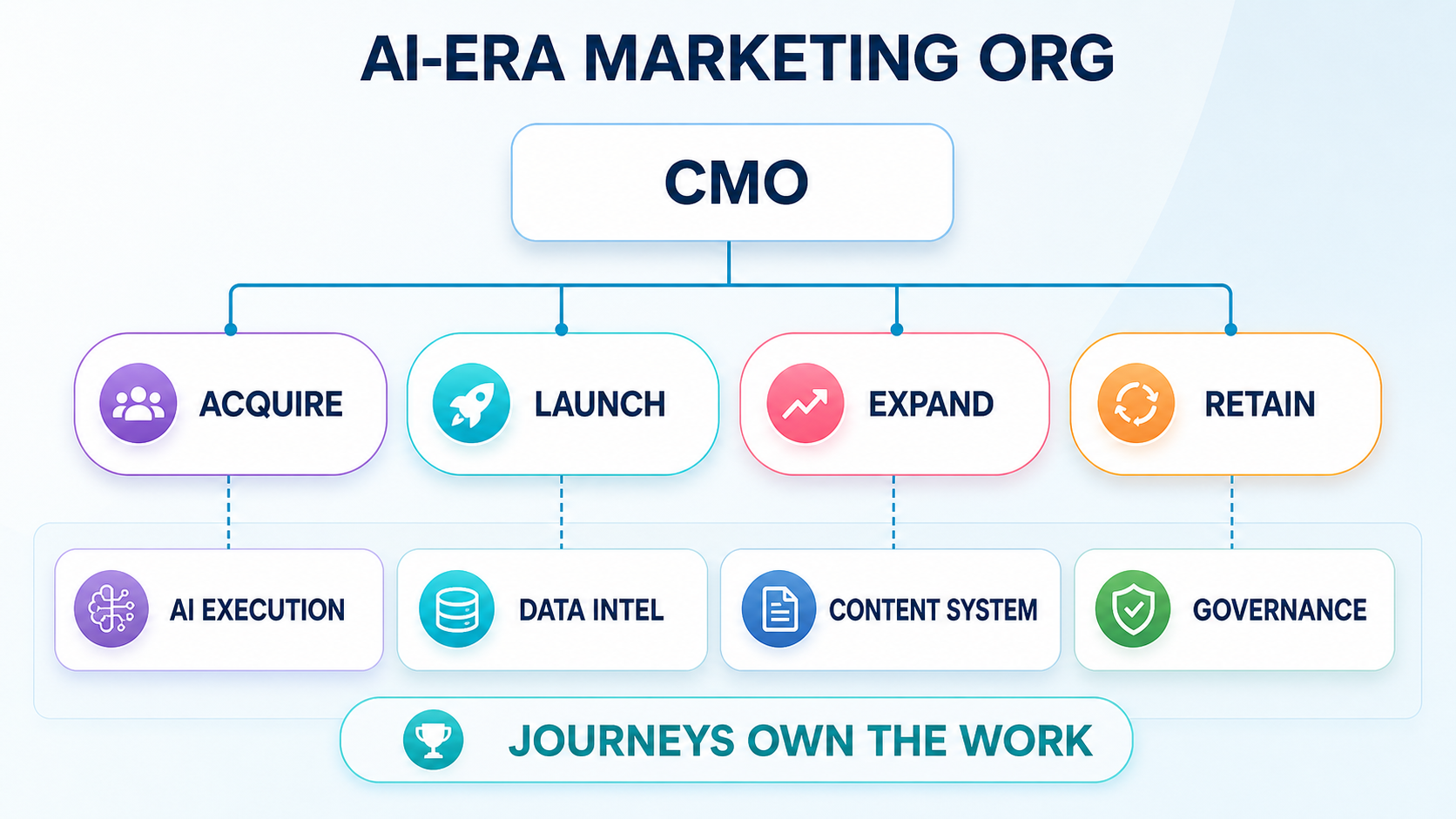
Try the shift below. The same product launch, ABM motion, or retention push behaves differently depending on whether the organization is built around channels or around an intelligent growth system.
Interactive · Old org vs. growth system
Drag the handle or use the slider.
How to read it
Drag right to reveal the AI-era operating model; drag left to see the channel org it replaces.
Midpoint: this is the transition zone where teams keep specialists but reorganize work around journeys.
Old model
Teams own channels, briefs move by handoff, and performance is learned after the campaign ships.
New model
Journey pods own outcomes, shared agents execute across channels, and data feeds the next decision loop.
A Possible AI-Era Marketing Org Chart
The future marketing org is not built around channels. It is built around layers:
- Growth Strategy and Market Intelligence
- Journey Orchestration Teams
- AI-Enabled Execution Systems
- Brand, Content, and Experience System
- Data, Insights, and Decision Intelligence
- Trust, Governance, and Enablement
The "web team" does not disappear. Its capabilities become part of an experience system and journey orchestration layer.
The "social team" does not disappear. Its expertise becomes part of audience engagement, influence, and distribution strategy.
The "email team" does not disappear. Its knowledge becomes part of lifecycle journey design.
But the reporting lines and operating model change. Teams are no longer organized primarily by where the work is published. They are organized by what customer and business outcome the work is meant to produce.
The Rise of the Journey Pod
The most important new unit may be the journey pod.
A journey pod is a small, cross-functional team responsible for a full customer motion:
- An ABM pod
- A product launch pod
- A customer expansion pod
- A lifecycle conversion pod
- An always-on AI visibility pod
- A retention and adoption pod
Each pod has access to shared AI agents, shared content systems, shared data, shared brand rules, and shared workflow automation.
A pod might include:
- A growth strategist
- A product or solution marketer
- A journey architect
- A content and storytelling lead
- A performance marketer
- A data and insights partner
- An AI workflow operator or agent orchestrator
- A brand and governance reviewer
The important part is not the exact staffing model. The important part is ownership. These people are not throwing work over the wall to separate channel teams. They are working inside a shared AI-enabled operating system that can execute across channels.
The pod owns the outcome. AI and shared services help execute the work.
New Roles Will Emerge
As channel boundaries blur, new roles become more important.
- The Journey Architect designs end-to-end customer motions across web, email, social, sales, events, communities, search, and AI answer engines.
- The AI Marketing Orchestrator configures agents, workflows, prompts, approvals, and automations that turn marketing intent into execution.
- The Content Systems Lead manages modular content, brand voice, metadata, reuse, localization, and content readiness for AI-driven distribution.
- The Brand Trust and Governance Lead ensures AI-generated work remains accurate, compliant, on-brand, and appropriate for the market.
- The Audience Intelligence Lead connects first-party data, market signals, account behavior, intent, and performance into actionable recommendations.
- The Experimentation Lead manages testing velocity across messages, offers, pages, segments, channels, and journeys.
- The AI Visibility Lead focuses on how the brand appears not only in Google, but in AI answer engines, copilots, agents, and recommendation systems.
These roles are not simply "AI prompt people." They are the connective tissue between strategy, systems, content, data, and execution.
HubSpot reports that over 92% of marketers plan to use or already use SEO optimization for traditional and AI-powered search engines, while nearly 30% report decreased search traffic as consumers turn to AI tools. That is not just an SEO problem. It is an operating model problem. The brand's answer-engine presence depends on content, data, proof, distribution, and consistency across surfaces.
The CMO Role Also Changes
The CMO becomes less of a campaign executive and more of an operating model designer.
Gartner reported that 65% of CMOs believe AI will dramatically transform their role within two years. BCG's 2026 work on agentic marketing also notes that roughly half of CMOs say the marketing organization now leads AI investment decisions in the function.
That matters.
Marketing is no longer just a consumer of AI tools bought by IT. Marketing is becoming one of the places where AI changes the work most visibly: content, personalization, insights, experimentation, campaign execution, customer journeys, and brand governance.
The CMO's job shifts from managing departments to designing a growth system:
- What work should be done by humans?
- What work should be done by AI agents?
- What work should require approval?
- What context should AI have access to?
- What data is trusted?
- What content is reusable?
- What workflows should be standardized?
- What decisions should be automated?
- What should remain deeply human?
The best CMOs will not simply ask teams to "use AI." They will redesign the operating model around AI.
What Happens to Agencies?
Agencies will also be affected.
If AI reduces the cost of production, agencies can no longer differentiate primarily on volume: more banners, more copy, more variants, more reports.
Their value moves upstream and downstream.
Upstream, agencies help with strategy, brand, narrative, creative platforms, market insight, and transformation. Downstream, they help with operating model design, experimentation, AI governance, journey optimization, and specialized execution.
The agency relationship becomes less about outsourcing production and more about augmenting the company's intelligent growth system.
Smaller in Some Places, Stronger in Others
AI will reduce the need for some forms of manual coordination and repetitive production. But it will increase demand for judgment, strategy, systems thinking, creativity, governance, and data fluency.
The roles most exposed are the ones that mainly move assets from one step to another, resize content, produce first drafts, compile reports, manually QA repetitive items, or coordinate handoffs across fragmented systems.
The roles that become more valuable are the ones that define direction, understand customers, shape narrative, design journeys, manage AI systems, interpret signals, and make high-quality decisions.
That is the same pattern we are seeing in software. As AI handles more implementation, humans move toward architecture, validation, product judgment, and system-level ownership.
Marketing will follow.
The Org Chart of the Future Is a System
The biggest mistake would be redrawing the same old org chart with "AI" added as a box.
That misses the point.
The AI-era marketing organization is not simply:
- CMO
- AI Team
- Everyone Else
It is:
- CMO
- Strategy
- Journey Pods
- Shared AI Execution Layer
- Content and Brand System
- Data and Decision Intelligence
- Governance and Enablement
AI becomes embedded into the operating model, not bolted onto the side.
The future marketing org will be judged less by how many campaigns it launches and more by how quickly it learns. Less by how many assets it produces and more by how effectively it changes customer behavior. Less by how many channel teams it has and more by how intelligently it connects context, content, data, and action.
The Real Shift
The old marketing org was built for production scarcity.
The new marketing org is built for decision velocity.
When content generation becomes abundant, the scarce resources become clarity, taste, trust, context, and coordination.
That is why the org chart changes.
Not because AI replaces marketing. Because AI changes what marketing is.
Marketing moves from channel management to journey orchestration. From campaign production to growth systems. From functional silos to AI-enabled pods. From manual execution to human-guided intelligence. From "who owns the channel?" to "who owns the customer outcome?"
That is the future of the marketing organization in the age of AI.
Interactive · Ask this article
Every essay here answers for itself.