Draft - Agentic Work
Agentic X Is Too Small
The market is renaming every application category as Agentic X. That may help adoption, but it risks preserving the same silos AI should help us move beyond.
June 11, 2026
5 min read
The Agentic Practice
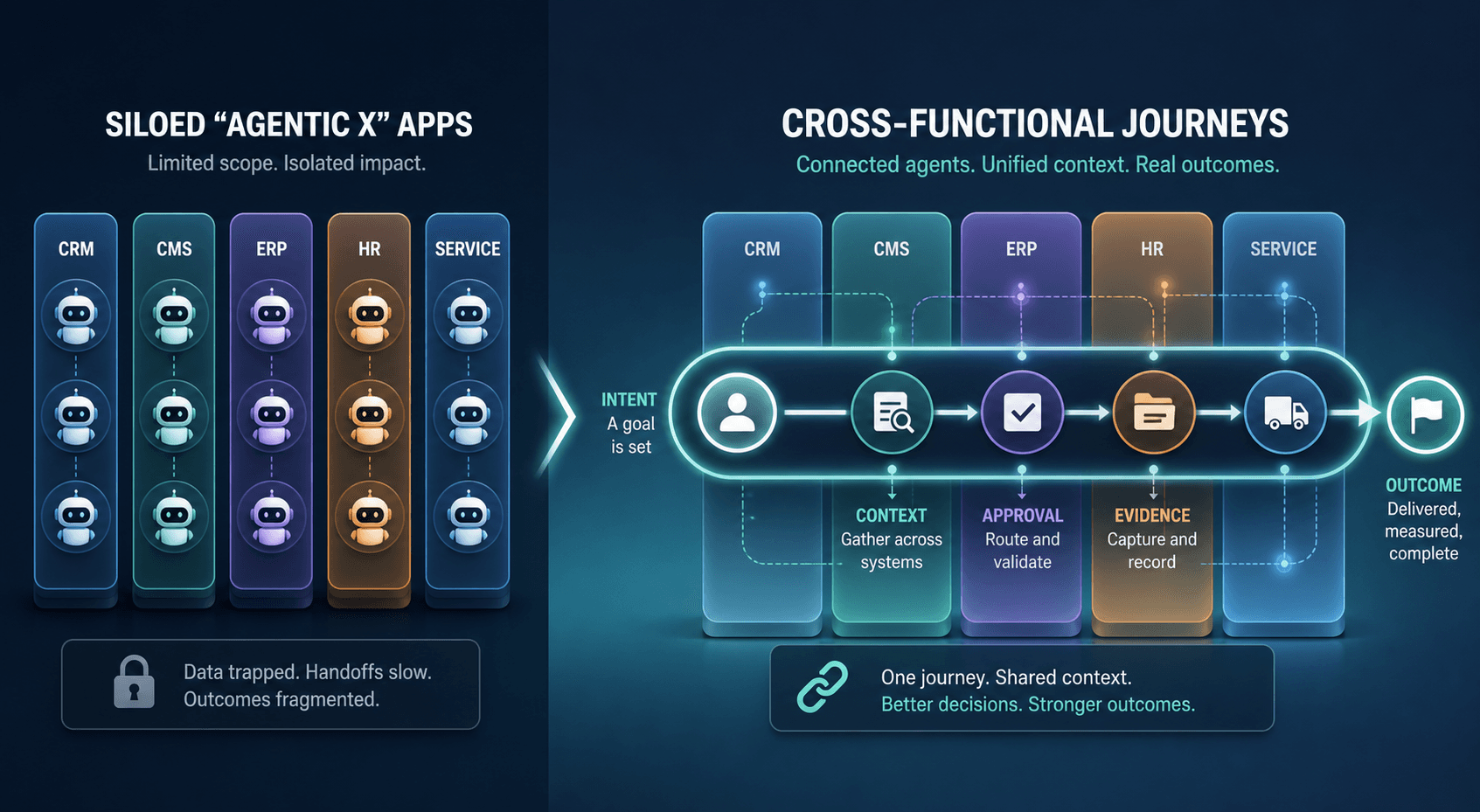
Agentic X is a transitional label, not the final operating model.
The durable unit of agentic work is the journey, not the application category.
Companies should design around outcomes that cross systems, records, teams, and approvals.
The fastest way to make a new technology feel familiar is to attach it to an old category.
That is what is happening with agentic AI. Agentic CRM. Agentic ERP. Agentic contact center. Agentic marketing. Agentic HR. Agentic service management. Give it a quarter and someone will ship Agentic Expense Approvals.
The pattern makes sense. Buyers understand categories. Analysts rank categories. Procurement budgets by category. Product marketing needs a short phrase that says, "the thing you already know, now with agents."
But the framing is too small. It takes the most interesting part of agentic AI and squeezes it back into the old enterprise map: the same application silos, with smarter workers inside them.
That may be the first step. It should not be the destination.
Everyone Is Renaming, Nobody Is Redrawing
The market signal is everywhere. Salesforce calls itself the "#1 Agentic CRM" and talks about agentic contact centers and agentic commerce. Microsoft Dynamics 365 speaks agentic ERP. Creatio: Agentic CRM. Hightouch: Agentic Marketing Platform. Wisq: Agentic HR. Stripe: Agentic Commerce Suite. Kyndryl: Agentic Service Management. Every name above is in the sources list — this is not a strawman.
To be clear: these are not bad ideas. They are exactly what the first phase should look like. Take a known domain, add agents, make the domain more useful. CRM should become more agentic. So should ERP, HR, finance, service, and marketing.
The trap is subtler. When every existing category becomes Agentic X, the agent becomes a feature of the application — and the company keeps thinking in applications.
The Silo Gets Smarter
Enterprise software was built around departments and records. CRM owns pipeline. CMS owns content. ERP owns money. HR owns people. Service owns tickets. That structure is useful — it gives work a place to live.
But the work itself does not stay inside those borders. A renewal crosses CRM, product usage, support history, legal terms, pricing, finance approvals, and the story the customer believes about value. A product launch crosses research, messaging, legal claims, web content, sales plays, and proof. No serious business outcome fits inside one application.
So if the agentic upgrade happens only inside each application, the company gets smarter silos. Run the experiment yourself:
Interactive · Run the renewal journey
It loops on its own — hover to pause, click a step to inspect.
CRM
⚙ agentic crm
Marketing
⚙ agentic marketing
ERP
⚙ agentic erp
Support
⚙ agentic support
Legal
⚙ agentic legal
Usage signal · inside Support: Analytics flag: the customer stopped using the module they pay most for.
Each silo got an agent and got faster at its fragment. But the journey is nobody's — context drops at every handoff, and the customer still experiences the seams.
The App Got Agentic. The Work Didn't.
Take marketing. An agentic marketing platform can build audiences, generate creative, assemble campaigns, and optimize performance. Genuinely useful. But nobody's quarterly goal is "marketing activity." The business needs to launch the campaign, convert the segment, correct the misconception.
And so: the campaign still waits for customer insight that lives in another system. The claims still need legal evidence from another workflow. The sales deck still drifts from the website. The AI answer still cites last year's proof.
The marketing platform became agentic. The work did not.
Same story in CRM. An agentic CRM can qualify leads, draft outreach, and prep call plans. But a renewal does not live in the opportunity record — it lives in product experience, support history, contract terms, executive priorities, and competitive pressure. Trap the agent inside the CRM frame and it will write you a beautiful renewal email, and miss the reason the customer is leaving.
The Real Unit Is the Journey
Most Agentic X language still asks application-shaped questions: what jobs can an agent do inside CRM? Inside ERP? Inside HR?
The better question is work-shaped:
What journey is the business trying to accomplish — and which systems, agents, humans, policies, and artifacts need to participate?
A journey is a real design object. It has an intent and an owner. A current state and a desired one. Participating systems, human decisions, agent responsibilities. A context graph, a policy boundary, approval points, artifacts produced along the way, and a feedback loop after it completes.
An application feature asks what a user can do in a system. A journey asks what progress the business can make across systems.
Agentic X Is a Bridge
You cannot skip the application layer, and you should not want to. The records, permissions, workflows, and domain models still matter. Enterprise applications are where business context already lives — which is exactly why agents start there.
So the problem is not that Agentic X is wrong. The problem is treating it as complete. Agentic X is a bridge from application-centric software to journey-centric work. Bridges are useful. Just know which side you are walking toward.
A Better Test for Agentic Products
A vendor demo will answer the easy questions: what the agent can do in the app, which records it can touch, which tasks it automates. The questions that decide whether you are buying a feature or an operating model are different. Score your favorite "Agentic X" product honestly:
Interactive · The Agentic X scorecard
Six questions the demo won't answer for you.
1.Can it name the end-to-end journey it improves — not just the tasks it automates?
“It drafts emails faster” is a task. “It carries a renewal from risk signal to signed terms” is a journey.
2.Does it know what happens before and after its application's part?
If the demo starts when the record exists and ends when the record updates, you are looking at a silo.
3.Can it pull context from systems it doesn't own?
Support history, contract terms, usage data — the reason the customer is leaving rarely lives in one app.
4.Is there a human who owns the outcome, not just an approval click?
An approval gate is not governance. Somebody has to own “keep Acme, profitably.”
5.Does the work ship with an artifact — evidence that it was done well?
Output without provenance is a guess with good formatting.
6.Does the journey learn from each run?
If run #50 is no smarter than run #1, you bought automation, not an operating model.
Verdict
Answer the six questions — the meter does not care what the product is called.
The Map Gets a New Layer
The old map was systems of record: CRM, CMS, ERP, HRIS, ITSM. They survive. But above them, companies will add systems of journey. Not one giant orchestration monster — a practical stack: a shared context layer that tells agents what matters, a capability layer that exposes what each system can safely do, a journey layer that coordinates steps, a governance layer that defines owners and approvals, an artifact layer that preserves proof, and a learning layer that improves each run.
That is where competition moves. Not "my CRM has an agent" versus "your CRM has an agent," but:
Can this company accomplish the customer journey faster, with better judgment, clearer evidence, safer delegation, and a stronger feedback loop?
The Strategic Mistake
The mistake to avoid is using agents to reinforce the org chart. Sales gets sales agents. Marketing gets marketing agents. Finance gets finance agents. Each department gets faster at its fragment — and the customer still experiences the handoffs, the manager still chases status, and the AI still lacks the full picture.
That is not an agentic operating model. That is departmental automation with better branding.
The New Question
Agentic X is useful. It makes the shift concrete and tells people where to start. But the question that matters is not "What is our Agentic CRM strategy?"
It is:
What journeys should our company be able to accomplish — and how should agents, humans, systems, context, and governance work together to accomplish them?
The future is not every application category with agents sprinkled on top. The future is work redesigned around outcomes that software can help carry from intent to result.
Agentic X is the naming phase. Journeys to be accomplished is the operating model.
Interactive · Ask this article
Every essay here answers for itself.