Draft - The Agentic Firm
Frontier Models Need a Learning Loop
The durable advantage is not picking the best model. It is building the system around the model that turns human judgment, work traces, evals, and governance into compounding firm IP.
June 14, 2026
8 min read
The Agentic Practice
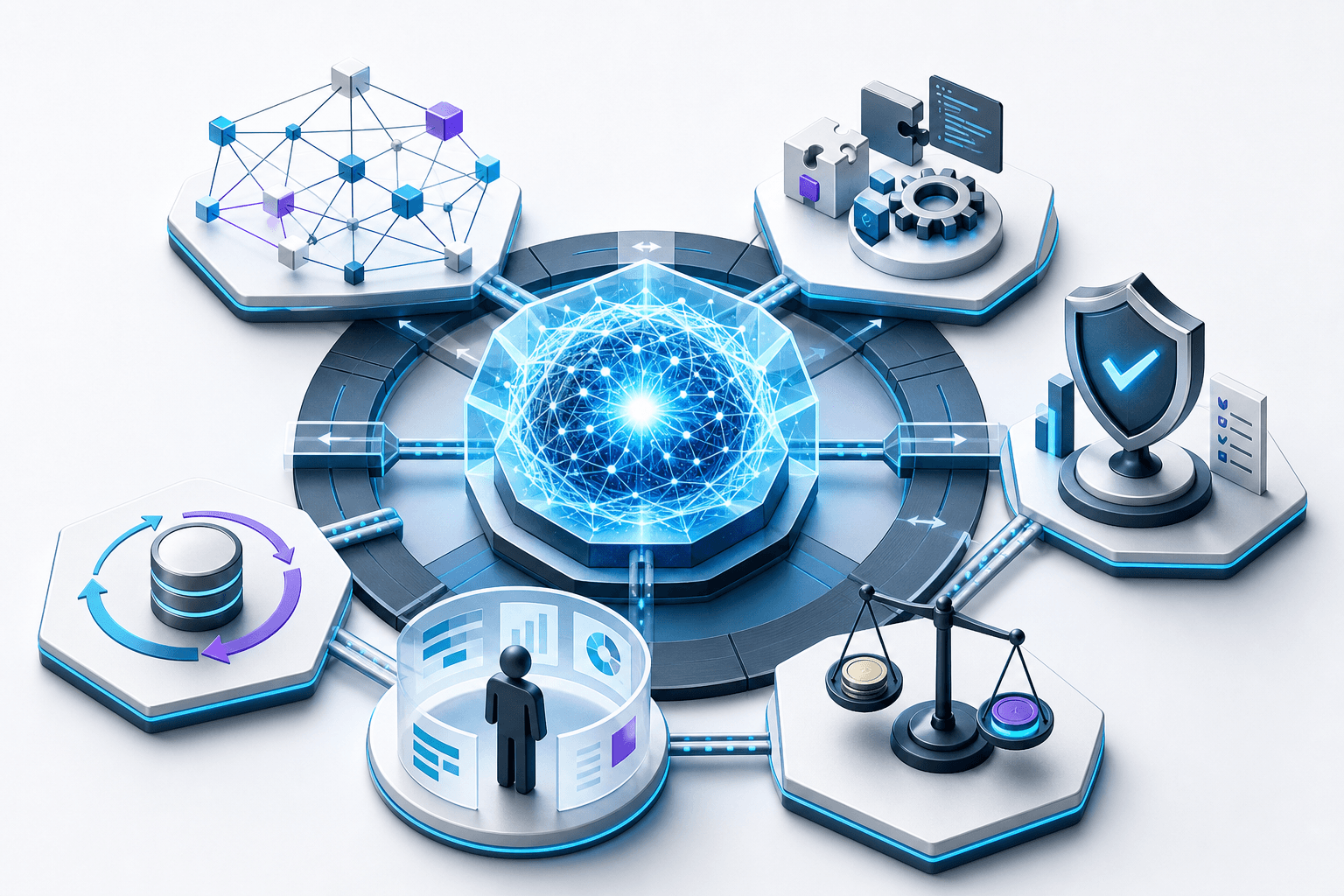
The model is not the asset; the learning loop around the model is the asset.
Human capital becomes more valuable when it can shape, evaluate, and compound token capital.
AI sovereignty means the firm can switch models without losing its institutional memory.
Satya Nadella's piece is important because it moves the AI conversation away from the model race and toward the structure of the firm.
The easy version of the AI strategy debate is: which frontier model wins?
His argument is more useful:
The future of the firm is the ability to compound learning across people and AI.
That is the right frame. It also exposes the strategic mistake most companies are about to make. They will rent intelligence, plug it into workflows, celebrate task offload, and call it transformation. But offloading a task is not the same as building institutional capability. A task disappears. A learning loop compounds.
The companies that matter in the AI economy will not be the ones that simply use the strongest model on a given day. They will be the ones that build a company-specific system around models: a knowledge catalog, tools, private evals, feedback traces, governance, and memory. That system is what turns human capital into token capital without surrendering the firm's judgment to someone else's model.
Human Capital Does Not Shrink
One of Satya's strongest points is that human capital becomes more valuable as token capital grows.
That cuts against the lazy version of the AI narrative. The lazy narrative says the machine gets smarter, so the human matters less. In real companies, the opposite is true. The more work gets delegated to AI, the more valuable the scarce human inputs become:
- What goal is worth pursuing?
- Which customer signal matters?
- What tradeoff should the company accept?
- Which exception is actually a pattern?
- What quality bar protects the brand, the margin, or the relationship?
Models can generate options. They can compress research. They can operate across systems. But without human direction, as Satya puts it, compute runs in circles.
The managerial work moves upstream. People spend less time performing every step and more time defining intent, teaching taste, setting constraints, noticing weak signals, and evaluating outcomes. That is not less human capital. That is human capital becoming the steering system.
Token Capital Is Not Just Tokens
The phrase "token capital" is useful because it names something companies have not had to measure before.
It is not simply token consumption. It is not how many prompts were sent or how many workflows were automated. Token capital is the AI capability the firm builds and owns. It is the reusable capacity to perform better because the organization has learned something.
That means token capital has to be attached to business memory. Otherwise it is rented cognition passing through a stateless interface.
A company that only prompts a frontier model gets temporary leverage. A company that captures the trace of work gets durable leverage. The difference is whether each run leaves behind a better system.
The Missing Middle Is a Knowledge Catalog
This is where Google's Knowledge Catalog work is worth paying attention to.
The product description is straightforward: Knowledge Catalog, formerly Dataplex, is an AI-powered data catalog and metadata management platform that provides a dynamic knowledge graph across structured and unstructured data so AI agents can use semantics and business context.
But the deeper concept is bigger than a data catalog.
It points at the substrate every agentic firm will need: a living map of business meaning that both humans and agents can read, update, govern, and traverse.
The repo's Open Knowledge Format proof of concept is especially useful because it makes the idea tangible. OKF represents knowledge as plain markdown files with YAML frontmatter. A concept can describe a table, an API, a metric, a playbook, a business process, or a reference. Concepts link to each other with normal markdown links, which turns a folder of documents into a graph. Index files support progressive disclosure, so an agent does not need to ingest the entire company at once. Git gives the corpus history, diffs, blame, review, and pull requests.
That is not just documentation. It is institutional memory with an operating surface.
The important design pattern is this:
- Knowledge should be human-readable without special tools.
- Knowledge should be agent-readable without bespoke SDKs.
- Knowledge should be versioned like code.
- Knowledge should mix structured metadata with narrative explanation.
- Knowledge should preserve relationships, citations, and lineage.
- Knowledge should be portable enough that the firm does not lose it when a model or vendor changes.
That maps directly to Satya's human capital plus token capital frame. Human capital supplies judgment, context, and explanation. The catalog turns that judgment into structured, reusable memory. Agents consume and enrich it. Private evals test whether the work improved. The next run starts smarter.
In other words, the learning loop needs a cataloged substrate. Without one, the loop has nowhere durable to write what it learns.
The Learning Loop Is the New IP
This is the practical center of the argument. The loop is where the firm turns work into advantage:
- A human sets an outcome, not just a prompt.
- The agent uses cataloged company context, tools, and policies to do the work.
- The result is evaluated against private business criteria.
- Human corrections, approvals, and exceptions become feedback.
- The catalog, workflow, memory, and evaluation set improve.
- The next run starts from a better company-specific state.
That is the hill-climbing machine. Not the model by itself. The model is a participant in the loop. The loop is the asset.
Run the system below in its weak and strong forms:
Interactive · The firm learning loop
Tune the system that surrounds the model.
Compounding readout
Loop maturity
34%
Token capital
33%
If model swaps
65% loss
State
Workflow memory
Human capital
Goals, judgment, relationships, taste
Cataloged context
The concepts, links, lineage, and citations the work depends on
Private eval
Did this improve the outcome the firm cares about?
Token capital
Reusable capability that survives the next task
A frontier model helps only while it is connected to this loop. The durable asset is the firm-specific system that turns each run into better judgment next time.
This is also why private evals matter so much. Public benchmarks tell you whether a model is generally capable. Private evals tell you whether the system is getting better at your work.
For an enterprise, that distinction is existential. A model can be excellent at generic reasoning and still weak at your claims process, your renewal motion, your customer language, your regulatory boundary, your product taxonomy, your pricing exceptions, or your pattern of executive escalation.
The eval that matters is not "is the model smart?" It is:
Is the firm learning faster because this system ran?
Sovereignty Is the Model-Swap Test
Satya's sharpest architectural test is whether a company can switch out a generalist model without losing the "company veteran" expertise built into the system.
That should become a board-level AI question.
If you swap the model and lose the firm's accumulated judgment, you did not own the learning loop. You owned prompts, integrations, and vendor dependency.
If you can change the model and preserve the memory, evals, workflows, policies, artifacts, and feedback traces that make the system better at your business, then you are building AI sovereignty.
This does not mean every company should train a frontier model. Most should not. It means every serious company needs control over the layer where its work becomes reusable intelligence.
That layer includes:
- Knowledge catalogs and context harnesses that expose the right facts at the right time.
- Workflow traces that preserve what happened, what changed, and why.
- Private evals tied to business outcomes.
- Reinforcement environments built from real organizational work.
- Governance rules that define permissions, review points, and escalation.
- Artifact systems that preserve evidence and make learning inspectable.
Without that layer, the firm is just sending its expertise into someone else's abstraction.
The Risk Is Not Automation. It Is Value Capture.
The warning in Satya's piece is political economy, not productivity theater.
If a small number of models absorb the world's organizational expertise and capture most of the economic return, the system becomes unstable. Industries would not just automate work. They would transfer their tacit knowledge outward and rent it back as a service.
That is the AI version of hollowing out.
The healthier equilibrium is a frontier ecosystem: models improve, but value also compounds inside firms, industries, countries, and communities. Platforms should enable more value on top than they capture inside.
That is not sentimental. It is the only version of the AI economy that companies, workers, regulators, and governments are likely to tolerate over time.
Our Perspective: The Firm Needs an Operating Layer
Satya names the strategic objective: compound human capital and token capital.
The next question is operational:
Where does that compounding actually live?
It will not live in chat alone. Chat is too ephemeral. It will not live in a single application. Work crosses systems. It will not live only in the model. Models change, prices change, capabilities change, and enterprise control requirements change.
The compounding layer has to be an operating layer for agentic work.
It should know the journey, the cataloged concepts, the tools, the policy boundary, the owner, the evaluation rubric, the artifacts produced, and the learning captured. It should make human judgment reusable without pretending human judgment has disappeared.
That is why the future of enterprise AI is not just "bring the best model to every employee." It is:
Build the system where every important piece of work makes the firm smarter.
The Management Implication
This also changes management.
Managers used to improve work by improving people, processes, incentives, and systems. Now they will also improve the token capital attached to their domain. A sales leader will not only manage reps and pipeline. They will manage the renewal intelligence loop. A marketing leader will not only manage campaigns. They will manage the system that learns which messages, segments, claims, and proof points move markets. A services leader will not only manage delivery. They will manage the trace library that turns delivery experience into future capability.
The best leaders will become stewards of learning loops.
That is a different skill from buying AI tools. It requires asking harder questions:
- What work should make us smarter every time it runs?
- Which human judgments are too important to disappear into a prompt?
- What private eval proves the system is improving?
- What memory should survive a model swap?
- Which artifacts make the learning inspectable?
- Who owns the loop when it crosses functions?
These are operating-model questions, not feature questions.
The New Strategic Question
The old question was: which software should we buy?
The current question is: which model should we use?
The durable question is:
What learning loops should this firm own?
That is where the next competitive advantage forms. Not in access to intelligence alone, but in the ability to turn work into proprietary improvement.
The frontier model matters. But a frontier without an ecosystem is unstable because the model alone has no memory of what the firm is trying to become.
The firm does.
The job now is to build the loop that lets it learn.
Interactive · Ask this article
Every essay here answers for itself.