Draft - Agentic Software
Google I/O 2026 Wasn't About AI. It Was About Management.
Google I/O 2026 looked like a wave of AI product announcements. The deeper signal was that software is shifting from passive tools to managed workers.
May 30, 2026
8 min read
The Agentic Practice
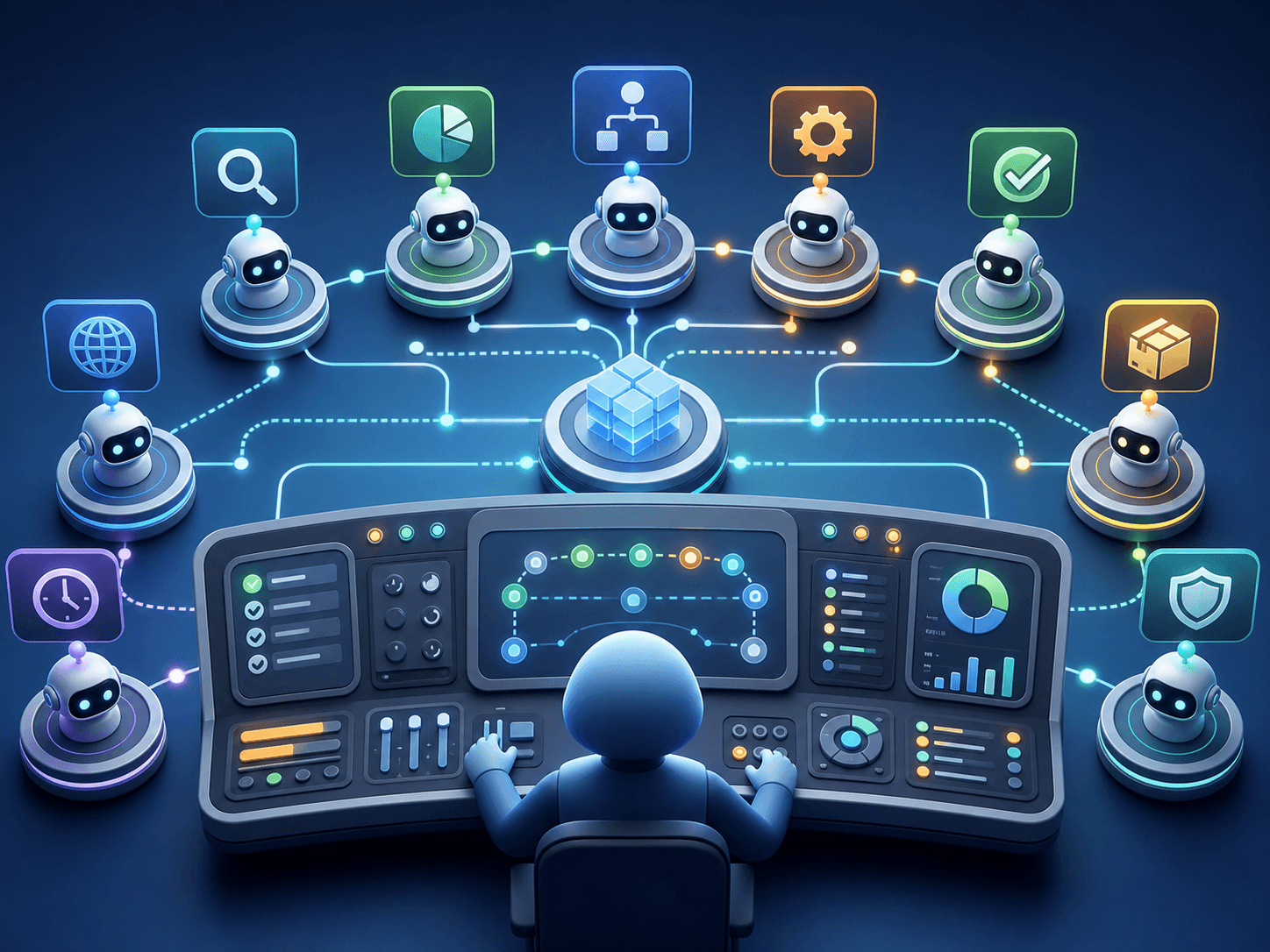
When software behaves like a worker, management becomes part of the interface.
The agentic web needs both knowledge access and operational capability.
Future AI products will compete on progress, governance, and coordination, not only intelligence.
Every year, technology conferences tell us where the industry is going.
Most years, the signal is buried under product launches, model benchmarks, and feature announcements.
Google I/O 2026 was different.
Beneath the headlines about Gemini 3.5, AI Search, Chrome updates, intelligent eyewear, and new creative tools was a bigger story:
Software is becoming organizational.
For decades, software has behaved like a tool.
Tools wait.
- You open them.
- You tell them what to do.
- They respond.
The software Google showed at I/O behaves differently.
It takes objectives, plans work, uses tools, coordinates actions, escalates when needed, and returns results.
In other words, it behaves less like a tool and more like a worker.
The most important takeaway from Google I/O is not simply that AI is getting smarter. It is that software is becoming organizational. That shift has profound implications for how we build products, design systems, manage teams, and interact with technology.
Signal 1: Search Is Becoming Delegation
The clearest example came from Search.
Google described AI Mode as the biggest upgrade to Search in more than 25 years. Search is moving beyond retrieving information and toward completing work on behalf of users. Information agents can research topics, monitor information over time, synthesize findings, and increasingly take action.
Google also reported major usage momentum: AI Overviews now has more than 2.5 billion monthly active users, and AI Mode has already surpassed one billion monthly active users.
At first glance, this appears to be an evolution of search.
It is not.
It is a replacement of the underlying interaction model.
For decades, the web operated on a simple premise:
- Humans ask questions.
- Systems return information.
- Humans perform the work.
Search was never the outcome. Search was a step toward the outcome.
Google is beginning to remove that step.
When a user asks, "Help me plan a family vacation," they do not want search results. They want a vacation plan.
When a user asks, "Monitor competitors in this market," they do not want links. They want ongoing intelligence.
The future of Search is not retrieval. The future of Search is delegation.
This distinction matters because it changes what users value. Historically, we optimized for relevance. Tomorrow, we may optimize for progress.
The best system will not be the one that finds the most information. It will be the one that gets the most work done.
Reference: Google Search: I/O 2026 updates
Signal 2: Software Is Becoming Asynchronous
One of the most underappreciated announcements was Gemini Spark.
Unlike traditional assistants, Gemini Spark is described as a personal AI agent that can help users get things done around the clock. Google positioned it as part of a more proactive Gemini app experience, alongside daily briefs, agentic assistance, and background help.
This may prove to be one of the most important shifts in human-computer interaction.
Historically, software has been synchronous.
- You ask.
- It responds.
- You click.
- It reacts.
Every interaction requires your presence.
Persistent agents break that model.
Instead of requesting a response, you assign an objective. The system works independently. Then it returns when the work is complete, blocked, or ready for review.
That sounds like a subtle change.
It is not.
It fundamentally changes the relationship between humans and software.
For decades, software has behaved like a machine. Machines require operators.
Persistent agents behave more like employees. Employees require managers.
The skills that made someone effective in a software-driven world may not be the same skills that make someone effective in an agent-driven world. The ability to define goals, establish constraints, provide context, and evaluate outcomes may become more valuable than the ability to operate software directly.
In that world, management becomes a core digital skill.
Not because everyone becomes a manager.
Because everyone gains workers.
Reference: Google: The Gemini app becomes more agentic
Signal 3: The Interface Is No Longer The Product
For most of computing history, the user interface was the product.
Every startup, enterprise platform, and software company competed on screens:
- Menus.
- Forms.
- Dashboards.
- Buttons.
- Workflows.
Google's Chrome announcements suggest that assumption may no longer hold.
WebMCP is a proposed web standard that lets websites expose structured tools for AI agents. Rather than forcing agents to navigate interfaces visually, websites can provide machine-readable actions and functions.
Think about what this means.
Today, when an agent books travel, purchases a product, or completes a task, it often interacts with websites the same way humans do.
- It clicks buttons.
- It reads pages.
- It fills forms.
- It waits for visual state changes.
This is slow, fragile, and error-prone.
WebMCP introduces a different model.
Instead of interacting with interfaces, agents interact with capabilities.
The website stops being only a collection of pages. It becomes a collection of actions.
Historically, we designed for human usability. Increasingly, we may need to design for agent usability.
If agents become primary users of software, interfaces become one consumer of functionality rather than the primary consumer.
For decades, the pattern was:
Human -> Interface -> System
Increasingly, the pattern becomes:
Human -> Agent -> System
The interface does not disappear.
It becomes optional.
Reference: Chrome for Developers: WebMCP
Signal 4: The Battle For The Agentic Internet Has Already Started
This becomes even more interesting when viewed alongside Microsoft's NLWeb initiative.
At a high level, both WebMCP and NLWeb are trying to solve the same problem:
How should agents interact with the web?
But they approach the problem from different directions.
NLWeb assumes the future interaction model is conversational. It focuses on helping websites expose knowledge, structured information, and natural-language interactions through standards such as Schema.org and conversational endpoints.
WebMCP assumes the future interaction model is operational. It focuses on helping websites expose actions, capabilities, and executable tools.
The distinction is useful:
- NLWeb asks: How do agents understand websites?
- WebMCP asks: How do agents use websites?
One treats the web as knowledge. The other treats the web as capability.
Both are likely necessary, because future agents need both.
They need to understand, and they need to act.
The interesting question is not which approach wins. The interesting question is whether websites will eventually need two architectures:
- One for humans.
- One for agents.
The web has spent thirty years optimizing for discoverability. The next decade may be about optimizing for usability by non-human actors.
References: Chrome for Developers: WebMCP and Microsoft: Introducing NLWeb
Signal 5: Software Is Becoming Organizational
This is the pattern that ties everything together.
Look across the announcements:
- Search agents.
- Persistent agents.
- Subagents.
- Tool orchestration.
- Agent development environments.
- Agent debugging tools.
- Permissions.
- Governance.
- Sandboxes.
These are not only traditional software concepts.
They are organizational concepts.
They are the same concepts we use when managing teams:
- Delegation.
- Oversight.
- Escalation.
- Specialization.
- Trust.
- Accountability.
The architecture of modern AI systems increasingly resembles the architecture of modern organizations.
That is why discussions about prompts increasingly feel incomplete.
Prompt engineering is a tool-level skill. The future challenges are organizational.
The better questions are:
- How should work be decomposed?
- When should agents escalate?
- How should humans review outputs?
- What permissions should agents have?
- How do we measure performance?
- How do multiple agents collaborate?
- What evidence must be preserved?
- What happens when the agent is wrong?
These are management questions.
Not just technical questions.
And that may be the biggest signal from Google I/O.
The future of software may look less like computing and more like organizational design.
Reference: Google: 100 things we announced at Google I/O 2026
Interactive · Five signals, one story
Click each card to read it as a manager.
0 of 5 signals read as a manager — flip them all.
The Real Story
Most coverage of Google I/O focused on models.
- Gemini 3.5.
- Gemini Omni.
- AI Search.
- Chrome updates.
- Intelligent eyewear.
Those are important.
But they are not the story.
The story is that software is no longer waiting for instructions. It is beginning to accept objectives.
That changes everything.
When software behaves like a tool, we optimize interfaces.
When software behaves like a worker, we optimize management.
The next decade will not simply be about building better AI. It will be about learning how to work with it.
And that is a much bigger shift than any model announcement.
Interactive · Ask this article
Every essay here answers for itself.