Draft - AI Architecture
Artifacts Are the New Blackboard
The real unit of AI-native work may not be the prompt, the chat, or even the agent. It may be the artifact: the durable work product that turns output into shared company memory.
May 23, 2026
7 min read
The Agentic Practice

Artifacts are the durable outputs that make AI work reusable.
Shared facts matter more than hidden conversational state.
The future agent workspace looks more like a shared workspace than a chat thread.
There is an old AI architecture idea that suddenly feels current again.
The blackboard architecture.
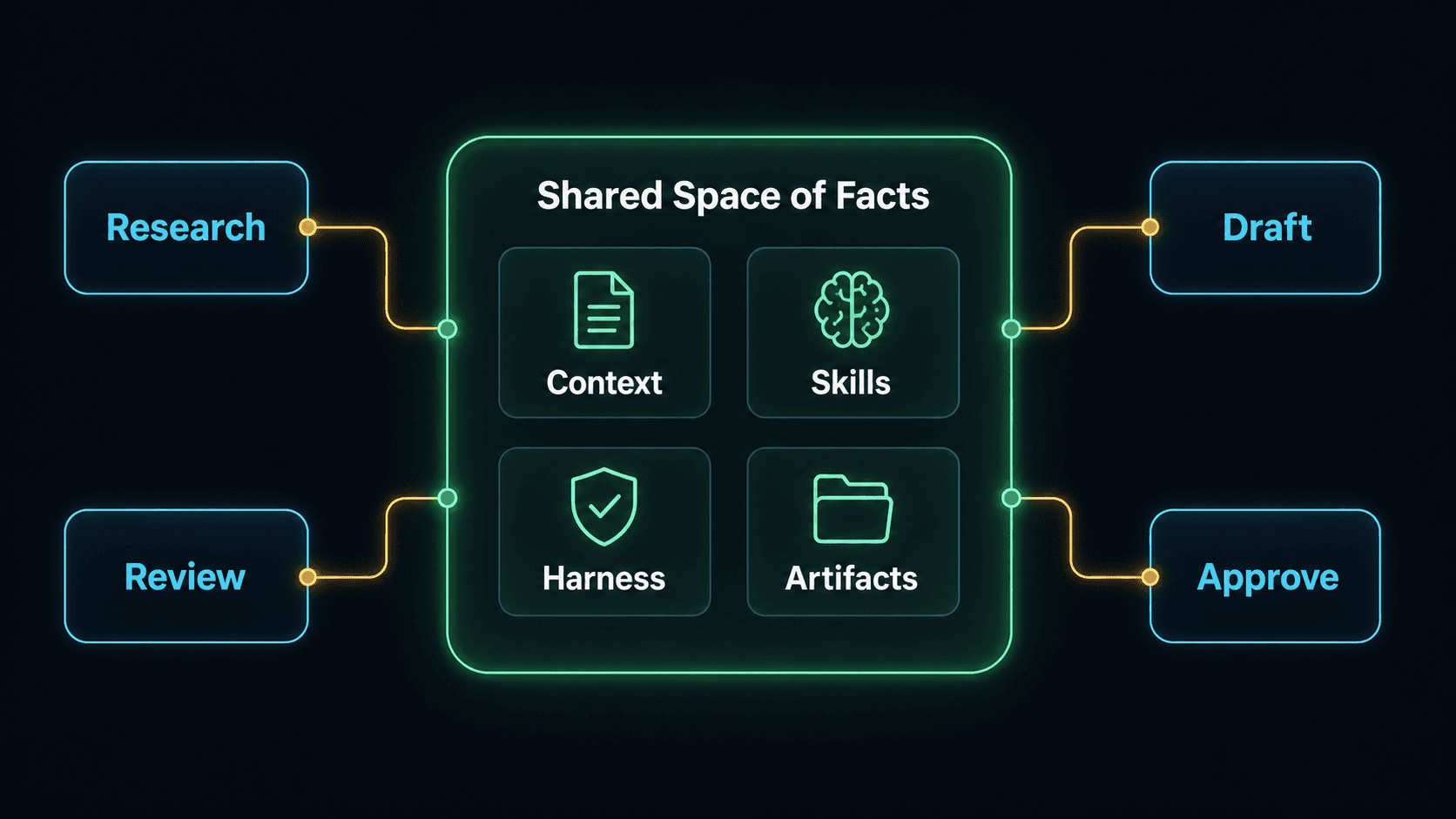
The basic picture is simple: instead of one central script telling every specialist what to do, multiple specialists observe and contribute to a shared space of facts. Each specialist knows how to react to part of the problem. The shared space holds the evolving state of the work.
That idea is nearly fifty years old, but it maps surprisingly well to the problem companies are starting to face with AI.
Most AI products still treat work as a conversation. A person asks for something. The model responds. Maybe tools are called. Maybe memory is searched. Maybe the system summarizes what happened so it can reuse it later.
But that is not how work really lives inside companies.
Companies do not operate only through conversations. They operate through outputs.
A strategy memo. A campaign brief. A sales deck. A product requirements document. A contract redline. A pricing model. A roadmap. A board presentation. A support escalation note. A customer narrative. A launch plan. A research packet.
These are not just files.
They are artifacts.
They are the surfaces where work becomes real.
The Missing Unit of AI Work
The more I think about AI systems inside companies, the less convinced I am that the primary unit should be the chat, the prompt, or even the agent.
The primary unit should be the artifact.
An artifact is a durable work product with identity, history, context, dependencies, and purpose. It is not just "the answer." It is the thing the organization can inspect, revise, reuse, govern, and build on.
This matters because most meaningful work does not end when a model produces text. The output has to enter the company.
Someone reviews it. Someone edits it. Someone approves it. Someone turns it into a deck. Someone uses it in a campaign. Someone cites it in a sales motion. Someone updates it when the product changes. Someone needs to know why it said what it said.
If the output is only a message in a chat thread, it is fragile.
If it is an artifact, it can become part of the operating system of the business.
The Shared Space of Facts
The blackboard framing is useful because it gives us a better mental model than "AI assistant."
Imagine a shared workspace where multiple AI behaviors, human reviewers, tools, and business systems all contribute to the same evolving surface.
For a company, that shared space is made of four things:
Context is the truth: the customer, product, policy, history, evidence, constraints, and decisions the system should understand.
Skills are the capabilities: the reusable ways the system knows how to research, draft, analyze, compare, critique, transform, and decide.
Harnesses are the operating rules: the permissions, workflow, approvals, controls, and accountability that make the work safe.
Artifacts are the work products: the documents, decks, briefs, plans, models, and files that carry state forward.
The artifact is important because it becomes a new fact in the shared space. Once the system produces a campaign brief, that brief is no longer just an output. It becomes something other behaviors can inspect, transform, compare, approve, and depend on.
That is how work compounds.
Why Chat Is Not Enough
Chat is a good interface for asking, exploring, and clarifying.
It is not a sufficient architecture for long-lived work.
A chat thread is usually organized around turns. Work inside a company is organized around objects. The object has a lifecycle. It has versions. It has owners. It has dependencies. It has approvals. It has evidence. It moves between teams and systems.
This is where the recent execution-lineage work is useful. The paper "From Agent Loops to Deterministic Graphs" argues that AI-native work should expose intermediate artifacts as stable computation boundaries, rather than leaving them embedded inside prompts and transcripts. In that model, a source, analysis, criteria document, decision, and final memo can each be treated as an artifact with dependencies.
The point is not simply to make the model better at writing. It is to make evolving AI-generated work maintainable under change.
That distinction feels critical.
An AI system that can produce a polished answer once is useful.
An AI system that can preserve what should not change, update what should change, and explain the dependency chain is infrastructure.
Interactive · Chat vs the blackboard
The same work, recorded two ways — it loops.
Chat history
Artifact · shared space of facts
The Log, the Graph, and the Artifact
The other paper, "The Log is the Agent," pushes a related idea from a different angle. Instead of treating logs as after-the-fact observability, it makes the append-only event log the source of truth. The graph is a projection of that log. Behaviors react to changes in the graph and emit new events.
That framing is powerful because it changes what "memory" means.
Memory is not just retrieval.
Memory is the ability to reconstruct what happened, why it happened, what depended on what, and what would change if one event changed.
For enterprise AI, that means the system should not only remember a summary of the conversation.
It should remember the production of the work.
- What context was used?
- Which skill generated the first draft?
- Which tool pulled the data?
- Which policy constrained the answer?
- Which human approved the exception?
- Which artifact was created?
- Which downstream artifact reused it?
That is a very different kind of company memory.
Artifacts Make AI Governable
Governance is hard when the work is hidden inside a conversational trace.
It becomes more tractable when the work is represented as artifacts with identity and provenance.
If a sales deck depends on a market research packet, and the packet depends on three source documents, and the pricing slide depends on an approved finance rule, the company can reason about the work.
It can ask:
- What evidence supports this claim?
- What changed since the last version?
- Which downstream assets need to be updated?
- Which parts were human-approved?
- Which outputs are safe to reuse?
- Which artifacts should be retired?
This is not only a technical concern. It is how businesses maintain trust in their own work.
The Company Workspace
The future interface for AI work may look less like a chatbot and more like a company workspace.
The workspace has a shared space of facts.
It has context: approved business truth.
It has skills: reusable capabilities that can research, draft, transform, critique, compare, and update.
It has harnesses: the rules that make those skills safe and accountable.
And it has artifacts: the documents, decks, briefs, plans, models, and records that become durable surfaces for collaboration.
Agents do not need to be imagined as little workers passing messages back and forth. They can be behaviors around the workspace. One behavior notices that a customer narrative is missing proof. Another assembles evidence. Another checks claims against policy. Another drafts the slide. Another asks for approval. Another records the decision.
The artifact is the center of gravity.
Not the conversation.
The Interface Starts to Change
If AI work moves away from chat, the experience has to change too.
A chat window is good at showing a sequence of messages. It is less good at showing the shape of the work.
Company work has shape.
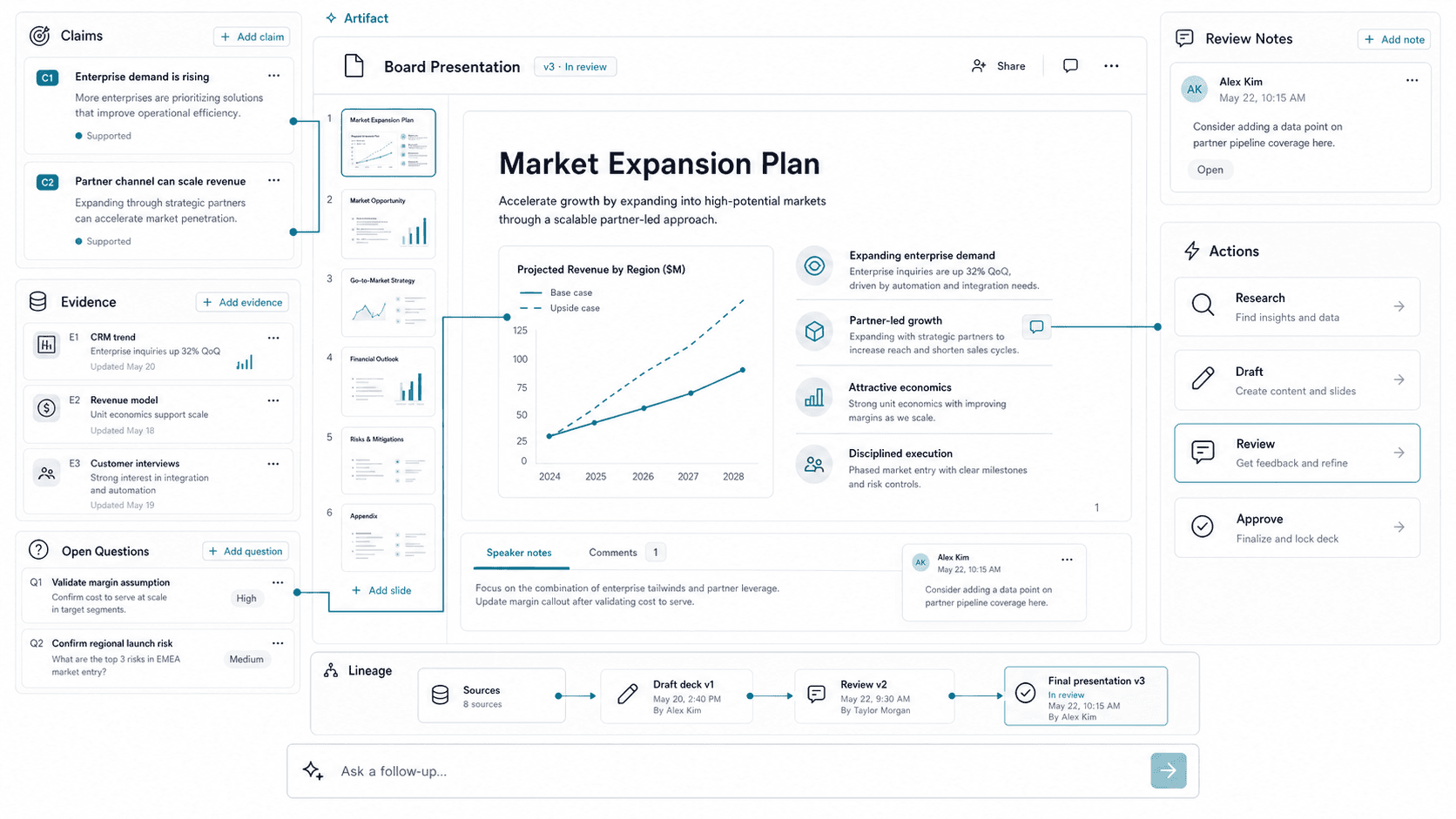
There is a draft. There are sources. There are assumptions. There are open questions. There are review notes. There are approvals. There are downstream assets that depend on the output.
Visually, that means the interface should start to look less like a transcript and more like a living workspace.
You might see the artifact itself in the center: a presentation, a model, a document, or a roadmap. The surrounding context is visible around it. The evidence sits beside the claim it supports. The policy constraint is attached to the section it affects. The reviewer comment is tied to the exact paragraph or slide. The system can show what changed, what stayed stable, and what still needs approval.
This is not just a design preference. It changes how people trust the work.
When the experience is only chat, the user has to reconstruct the state of the work from the conversation. When the experience is artifact-centered, the state is visible. The work product, its reasoning, and its dependencies can sit on the same surface.
That is the visual shift: from answering in a box to working on a shared object.
The Run Needs a Control Surface Too
There is another layer missing from the artifact-centered picture.
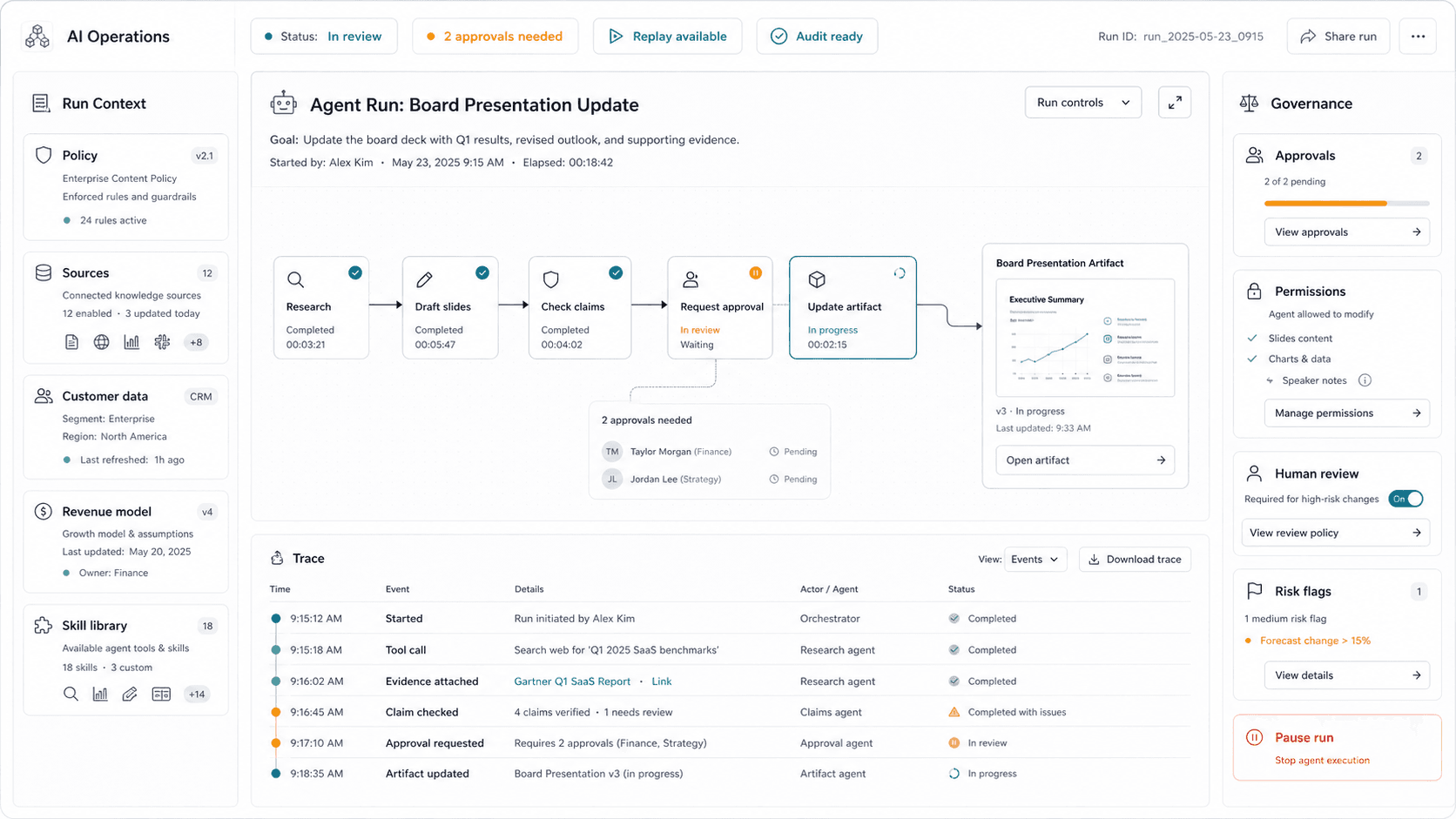
If AI systems are going to do meaningful work inside a company, the interface cannot only show the finished artifact. It also has to show the run that produced it.
This is where something like OpenAI Symphony becomes interesting as a pattern: a UI for governing agent work, not just prompting it.
A company does not only need to ask an agent to update a presentation. It needs to know which agent ran, which skills it used, which tools it called, what evidence it attached, what claims it checked, which permissions it had, where it paused, who approved it, and what artifact changed at the end.
That is a different interface from chat.
It is closer to an operations surface.
The artifact is still the center of the work, but the run is the record of how that work happened. The governance layer lets the business inspect the run, pause it, replay it, approve it, reject it, or understand why it produced a particular change.
The closest everyday analogy may be a bank transaction.
When you use a credit card to buy groceries, the bank does not simply overwrite your balance and move on. It records a transaction: the merchant, amount, time, authorization, status, and settlement path. Your balance is the result of those recorded events.
That is the same shape AI work needs. The presentation should not just change. The system should record the action that changed it: the run, the tools, the evidence, the approval, and the resulting artifact version.
This matters because agentic work will not be trusted just because the output looks polished. It will be trusted when the system can show its path through context, skills, harnesses, approvals, and artifacts.
The Risk of Detached Work
Every company already has artifacts. The problem is that they are usually disconnected from the system of reasoning that produced them.
The document exists, but the context is elsewhere.
The deck exists, but the evidence is scattered.
The approval exists, but the reasoning lives in a thread.
The file exists, but the dependency graph is invisible.
AI will make this problem more urgent because it will create more work products, faster. If those outputs are not tied back to context, skills, harnesses, and lineage, companies will become faster at producing detached artifacts.
The opportunity is to do the opposite.
Make every artifact part of the shared space of facts.
Make every meaningful output traceable.
Make every revision understandable.
Make every downstream use aware of what it depends on.
That is when AI stops being a better text generator and starts becoming part of how the company thinks, remembers, and works.
The old blackboard idea was about specialists contributing to a shared problem-solving space.
The modern version may be about AI systems, humans, tools, and policies contributing to shared artifacts.
That is where company memory becomes operational.
Interactive · Ask this article
Every essay here answers for itself.