Draft - AI Interfaces
The AI Interface Is Not a Pointer. It Is Multiplayer Work.
Google DeepMind's AI pointer is useful because it points away from detached chat. But the deeper interface shift is toward shared artifacts, agent presence, governed collaboration, and derivative work on a multiplayer canvas.
May 30, 2026
10 min read
The Agentic Practice
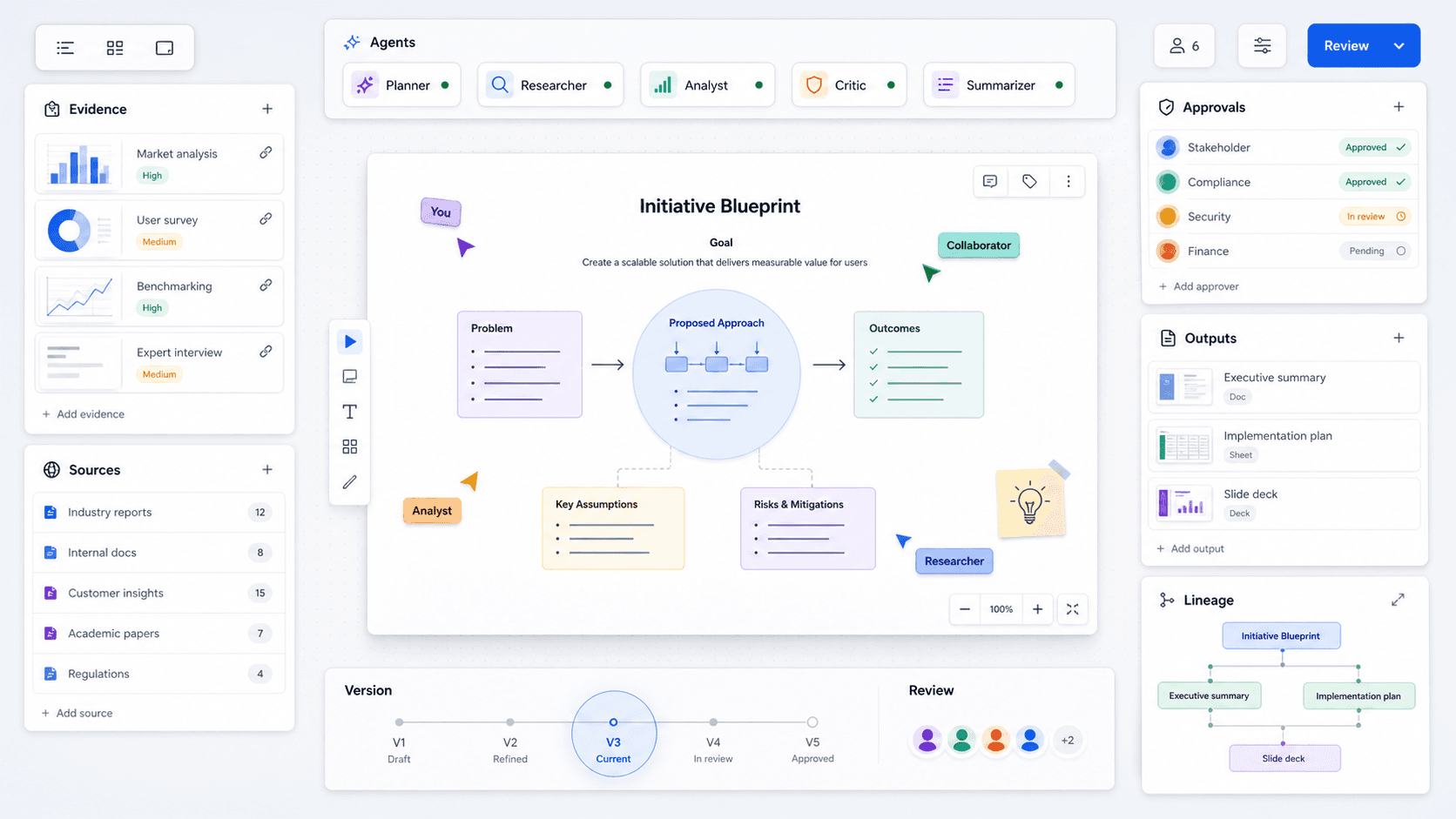
The next AI interface is collaborative, not just contextual.
Artifacts should become the shared surface where humans and agents work.
Agentic work needs presence, permissions, provenance, and derivative output flows.
Google DeepMind's AI pointer is a useful provocation.
The argument is simple: the mouse pointer has barely changed in fifty years, even though the work around it has changed completely. If AI can understand what the user is pointing at, the user can stop writing long prompts just to explain the obvious.
- That is a good idea.
- It is also too small.
The important part of the article is not the pointer. The important part is what the pointer admits:
AI cannot stay in a detached side window. It has to meet the user inside the work.
But once AI is inside the work, the deeper question changes.
It is not:
- What should the cursor do?
- How short can the prompt become?
- How much context can the model infer from the screen?
It is:
- What is the shared work surface?
- Who or what is allowed to act on it?
- How does the work remain inspectable after AI changes it?
- How do humans and agents collaborate around the same artifact over time?
That is where the bigger shift starts.
The future AI interface is not just a smarter pointer. It is not only a better chat window. It is a multiplayer workspace where humans and agents collaborate around durable artifacts.
The Pointer Is A Symptom
The AI pointer solves a real problem: context transfer.
Most AI tools force the user to describe the object of work in words:
- Which paragraph?
- Which chart?
- Which cell?
- Which image?
- Which slide?
- Which product?
- Which part of the code?
That is a strange tax. The computer already has the object on screen, but the user still has to reconstruct it inside a prompt.
Pointing changes that. It lets the user say less because the environment can see more.
That matters because people do not naturally collaborate by producing perfect instructions. They gesture. They reference nearby objects. They use shorthand:
- "Move this."
- "Use that version."
- "Make this stronger."
- "Turn this into a slide."
- "What does this mean?"
- "Compare these."
The pointer is useful because it brings AI closer to that interaction pattern.
But it is still mostly a single-user affordance.
It answers one question well:
How does one person invoke AI against something on screen?
It does not answer the more important question:
What happens when that thing on screen becomes the shared object for many contributors?
That is where chat and pointer both start to feel incomplete.
- Chat is detached from the work.
- The pointer is attached to the work, but usually to one person's moment of intent.
- Neither fully represents work produced by teams of people and agents acting over time.
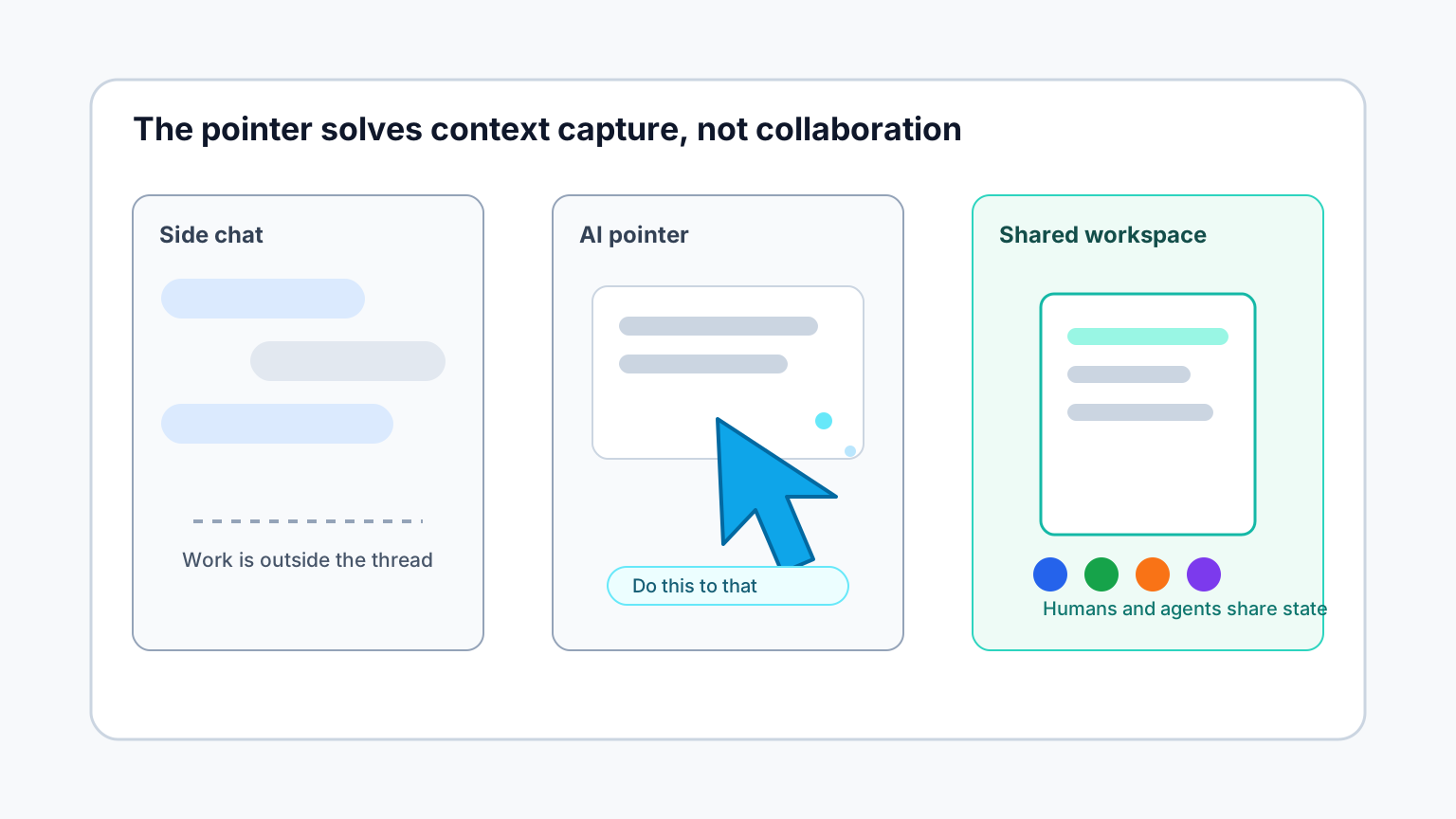
The pointer should be treated as a bridge, not the destination.
It proves that AI needs context from the work surface. It does not prove that the future interface is a cursor. The future interface has to represent shared state, shared authorship, shared accountability, and shared outcomes.
Speed Turns Interfaces Into Shared Spaces
There is a pattern in software history that feels obvious only after it happens:
When a category gets faster, collaboration moves closer to the work.
The pattern shows up again and again.
- Email made digital communication easier, but it preserved a handoff model: write, send, wait, reply. Slack did not merely make email shorter; channels made the conversation visible to a group, persistent across time, and organized around shared work context.
- Forums made publishing and discussion easier. Social feeds changed the tempo by collapsing expression, distribution, response, and recomposition.
- Desktop design tools made interface design powerful. Figma changed the work surface by making the design file multiplayer.
- Google Docs was not just a word processor in a browser. It made the document a shared place where people could edit, comment, suggest, and watch the work change together.
The lesson is not that every tool needs real-time cursors.
The lesson is that speed changes where collaboration happens.
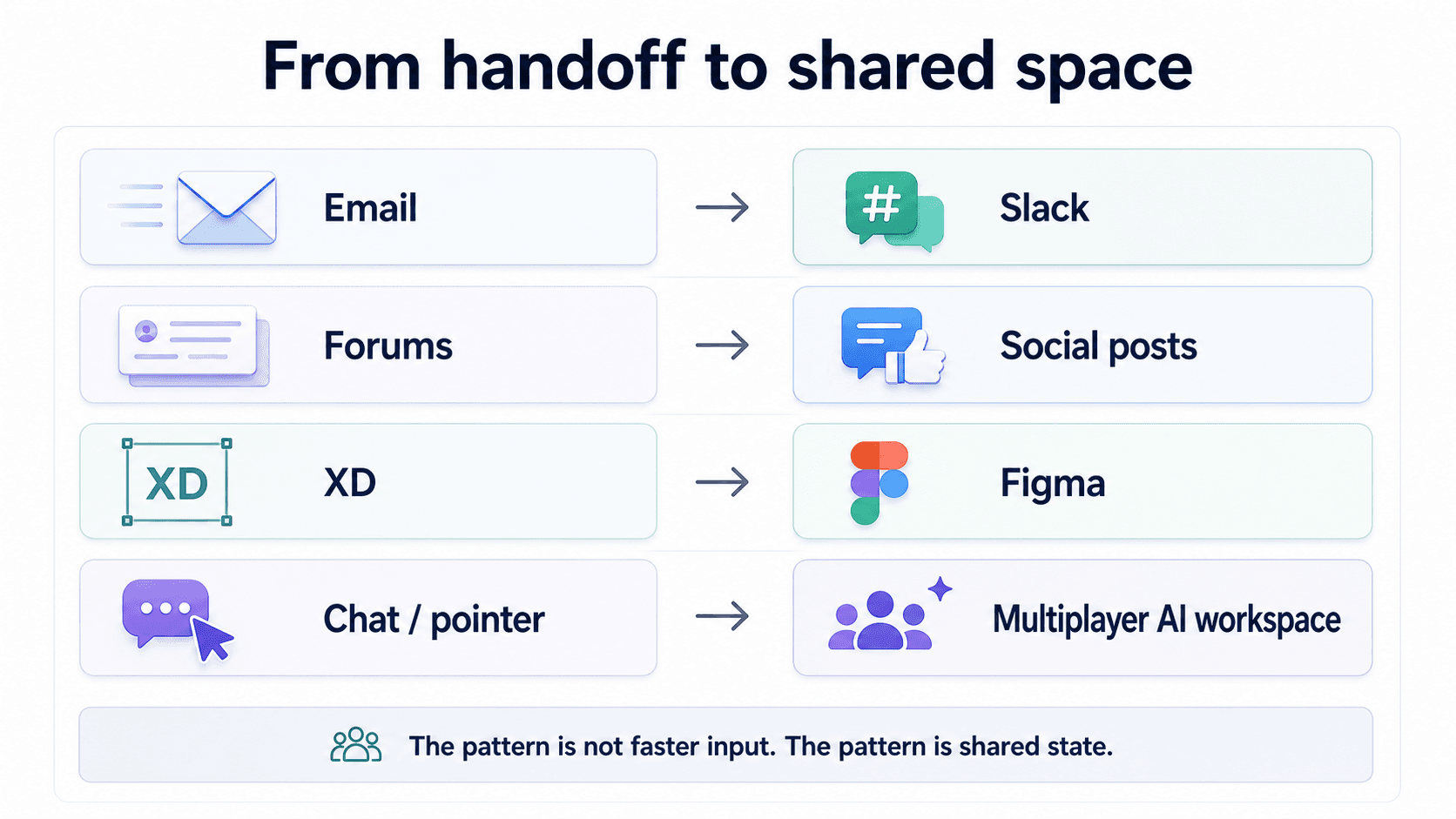
This matters for AI because the same pattern is starting again.
The first wave of AI interfaces made generation faster. Chat made it easy to ask for:
- A draft.
- A summary.
- An explanation.
- A plan.
- A rewrite.
- A comparison.
- A first version of almost anything.
But speed moves the bottleneck.
If one person can produce ten drafts in the time it used to take to produce one, the bottleneck is no longer only writing. The bottleneck becomes:
- Review.
- Context.
- Trust.
- Reuse.
- Approval.
- Transformation.
- Alignment.
That is why the next interface cannot only optimize prompting.
It has to optimize the collaborative life of AI-generated work.
The Artifact Becomes The Room
The blackboard framing still feels like the right foundation: work needs a shared space of facts.
In enterprise work, that shared space cannot be only a message transcript. It has to be the artifact.
An artifact is the thing the business can inspect, revise, approve, reuse, govern, and build on:
- A brief.
- A deck.
- A product requirement.
- A model.
- A campaign plan.
- A customer narrative.
- A contract redline.
- A content map.
- A research packet.
- A pricing scenario.
- A roadmap.
- A release note.
The distinction is simple:
- The AI pointer says: let AI understand the thing under the cursor.
- The artifact-centered interface says: make the thing itself the room where collaboration happens.
That difference is subtle, but important.
If the artifact is the room, then the AI does not merely answer a question about the artifact. It can participate in the artifact's lifecycle.
- It can attach evidence to a claim.
- It can flag that a slide depends on stale source material.
- It can propose a change while preserving the approved parts.
- It can show which human accepted or rejected a recommendation.
- It can generate a derivative output without losing the source lineage.
- It can explain what changed between versions and why.
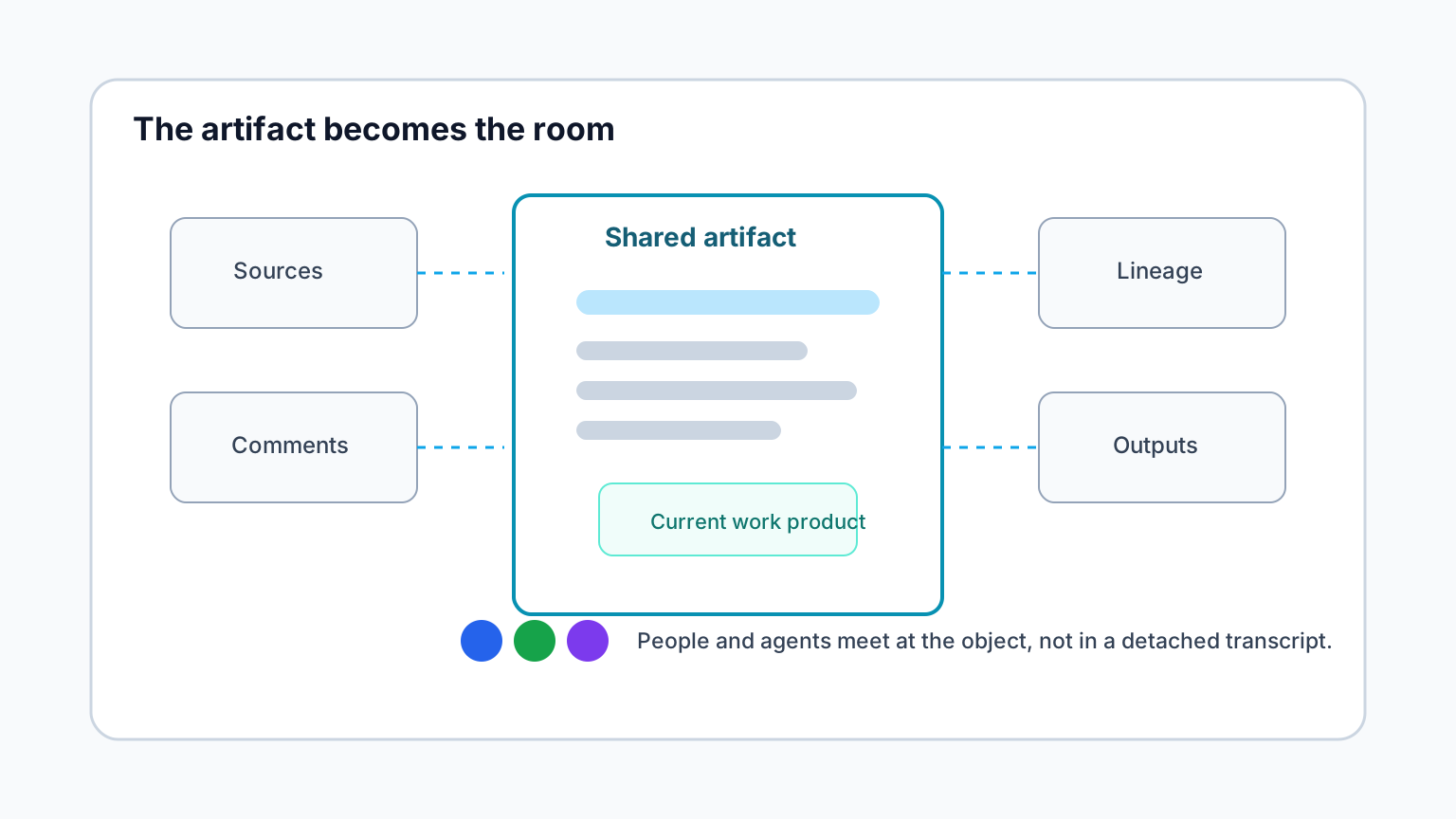
This is the biggest weakness of side-chat AI.
The model may generate useful work, but the work often has to be copied into the real system where review, approval, comments, edits, and downstream production happen.
That copy step breaks the chain:
- The answer leaves the conversation.
- The artifact loses the reasoning.
- The reviewer sees output without enough provenance.
- The next agent sees a document but not the decisions behind it.
- The organization accumulates more material, but not necessarily more memory.
An artifact-centered AI interface keeps the reasoning close to the object.
Not everything has to be visible all the time. But the system should be able to reveal the source, actor, action, dependency, and approval when the work requires it.
That is the difference between AI as a response engine and AI as part of the work system.
Interactive · The artifact is the room
Watch who is actually in the document.
Research agentAdded: 3 competitor pricing sources
Presence, attribution, and parallel work — the document behaves like a room, not a file.
Agents Need Presence, Permissions, And Memory
If agents are going to participate in work, they need a collaboration model that is closer to people than tools.
Not because agents are people.
Because collaboration systems need to show who or what is acting.
In a multiplayer design file, presence matters:
- You can see who is there.
- You can see what they selected.
- You can comment on the same object.
- You can inspect history.
- You can recover from mistakes.
Agentic systems need the same kind of affordances, adapted for non-human actors.
An agent should have visible presence:
- Name.
- Role.
- Scope.
- Current task.
- Current status.
An agent should have permissions:
- What it can see.
- What it can change.
- Which systems it can access.
- Which actions need approval.
- Which actions it can never approve itself.
An agent should have operational memory:
- Which sources were used.
- Which tools ran.
- Which claims were checked.
- Which versions changed.
- Which human approved the result.
- Which downstream artifact reused the work.
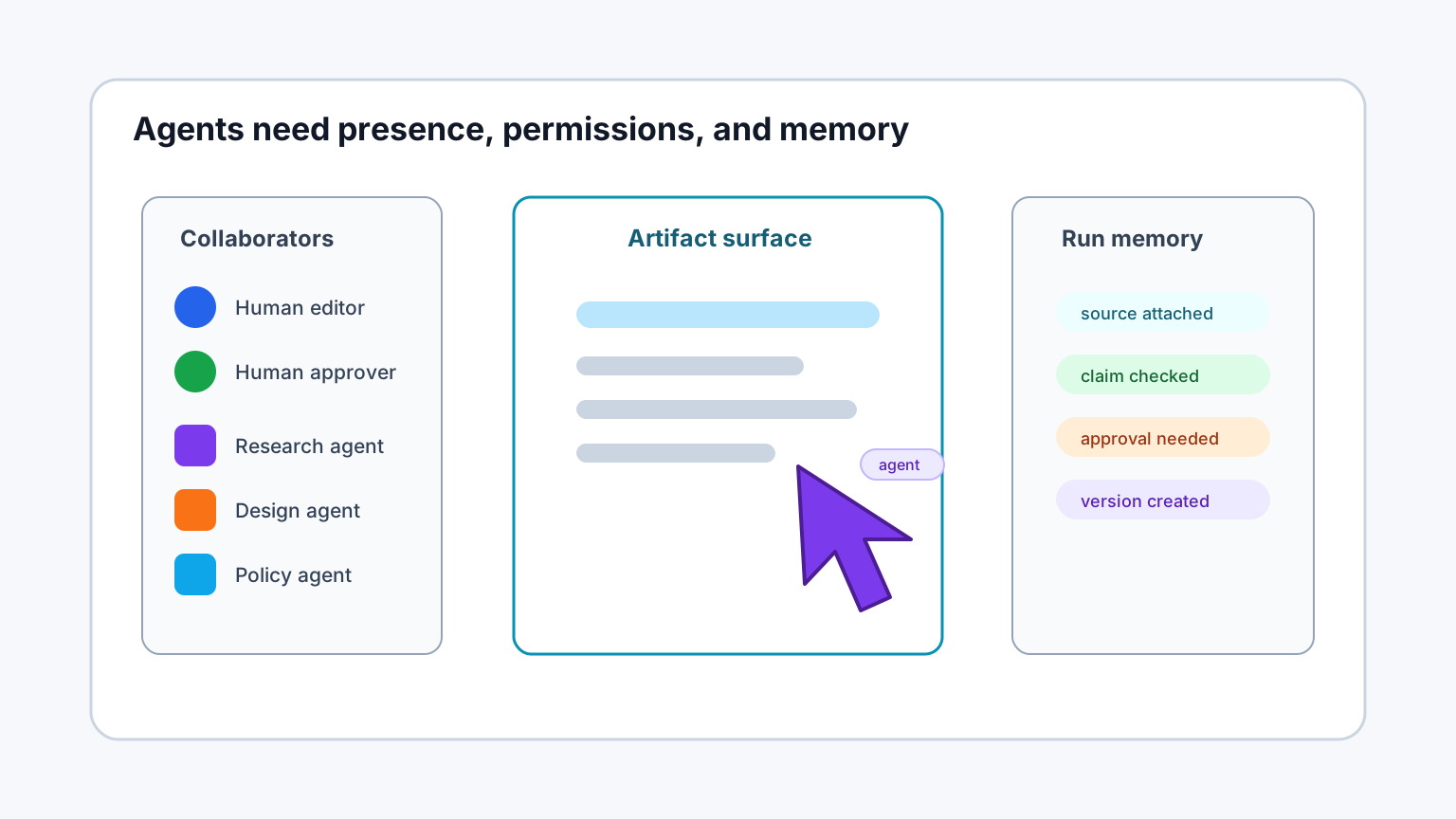
This is where human-AI interaction research becomes relevant. Mixed-initiative interfaces are not new. The old question was how to coordinate initiative between a person and an automated system without making the system annoying, opaque, or unsafe.
The current question is similar, but the stakes are higher because agents can operate across tools and over longer spans of work.
The design problem is not:
How do we make the agent feel human?
The design problem is:
How do we make the agent's participation inspectable enough for humans to collaborate with it?
That requires a few primitives:
- Presence: who or what is in the workspace.
- Intent: what each actor is trying to do.
- Scope: what each actor can see and change.
- Ownership: which actor is responsible for which part.
- Provenance: what evidence, tool calls, and decisions produced the result.
- Recovery: how humans pause, undo, reject, fork, or replay the work.
Without those primitives, agentic work becomes faster but harder to trust.
With those primitives, agents can become part of a real collaborative workforce: not equal to humans in judgment or accountability, but visible in the same work system.
The Next Canvas Creates Derivative Work
There is another reason the pointer is too small a frame: much of the future of AI work is derivative.
Not derivative in the negative sense.
Derivative in the operational sense:
One source artifact becomes many useful outputs.
That is how work already moves:
- A research packet becomes a strategy memo.
- A strategy memo becomes a board deck.
- A board deck becomes a customer-facing narrative.
- A customer narrative becomes web copy, sales enablement, campaign briefs, social posts, partner emails, event abstracts, localization briefs, and executive summaries.
Canva is one of the clearest signs of this direction.
Its AI tools are interesting not because they produce images from text. They are interesting because they sit inside a visual work surface where people already transform ideas into many formats.
The key pattern is not generation alone.
It is:
- Generation.
- Editing.
- Conversion.
- Resizing.
- Translation.
- Brand control.
- Recomposition.
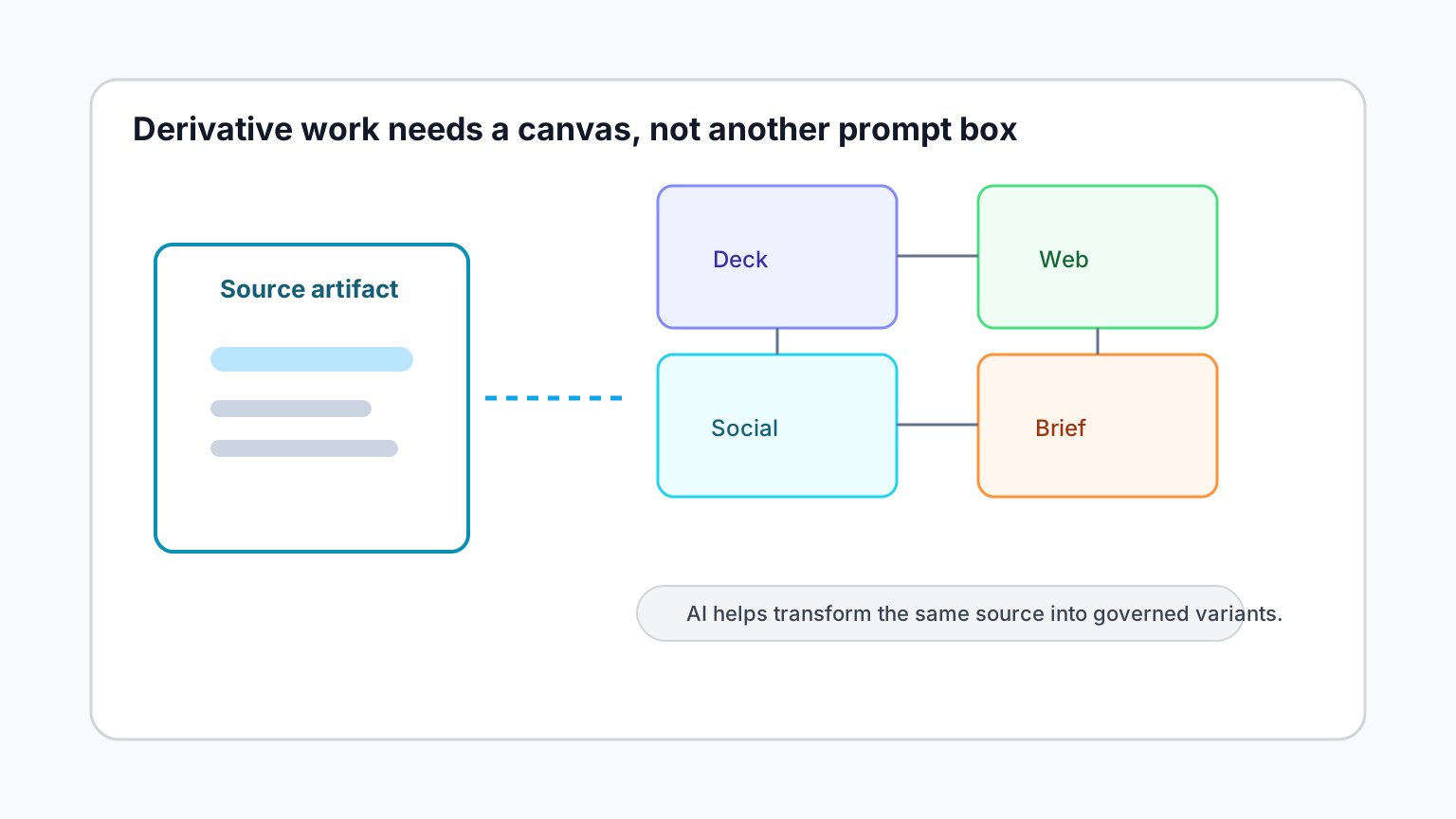
That is the interface implication:
AI needs a canvas for transformation, not only a prompt box for generation.
A prompt box is good when the desired output is singular.
A canvas is better when the work needs to:
- Fork.
- Remix.
- Compare.
- Recombine.
- Stay connected to source truth.
In enterprise work, this matters because every derivative output has risk.
- Did the social post preserve the approved claim?
- Did the slide cite the right source?
- Did the localized version keep the intended tone?
- Did the sales summary inherit a stale number?
- Did the campaign brief drift from the original strategy?
- Did the agent create a new artifact that should now become part of the company's shared memory?
The future interface should make those relationships visible.
It should let a human and an agent:
- Work from the same source artifact.
- Create variants.
- Inspect differences.
- Preserve lineage.
- Know which outputs are approved for use.
That is much bigger than pointing at a thing and asking AI to act on it.
It is a new creative and operational surface.
The Interface Is The Operating Model
The real endpoint is an end-to-end collaboration interface.
Not chat plus tools.
Not a pointer plus voice.
Not an agent hidden behind a progress spinner.
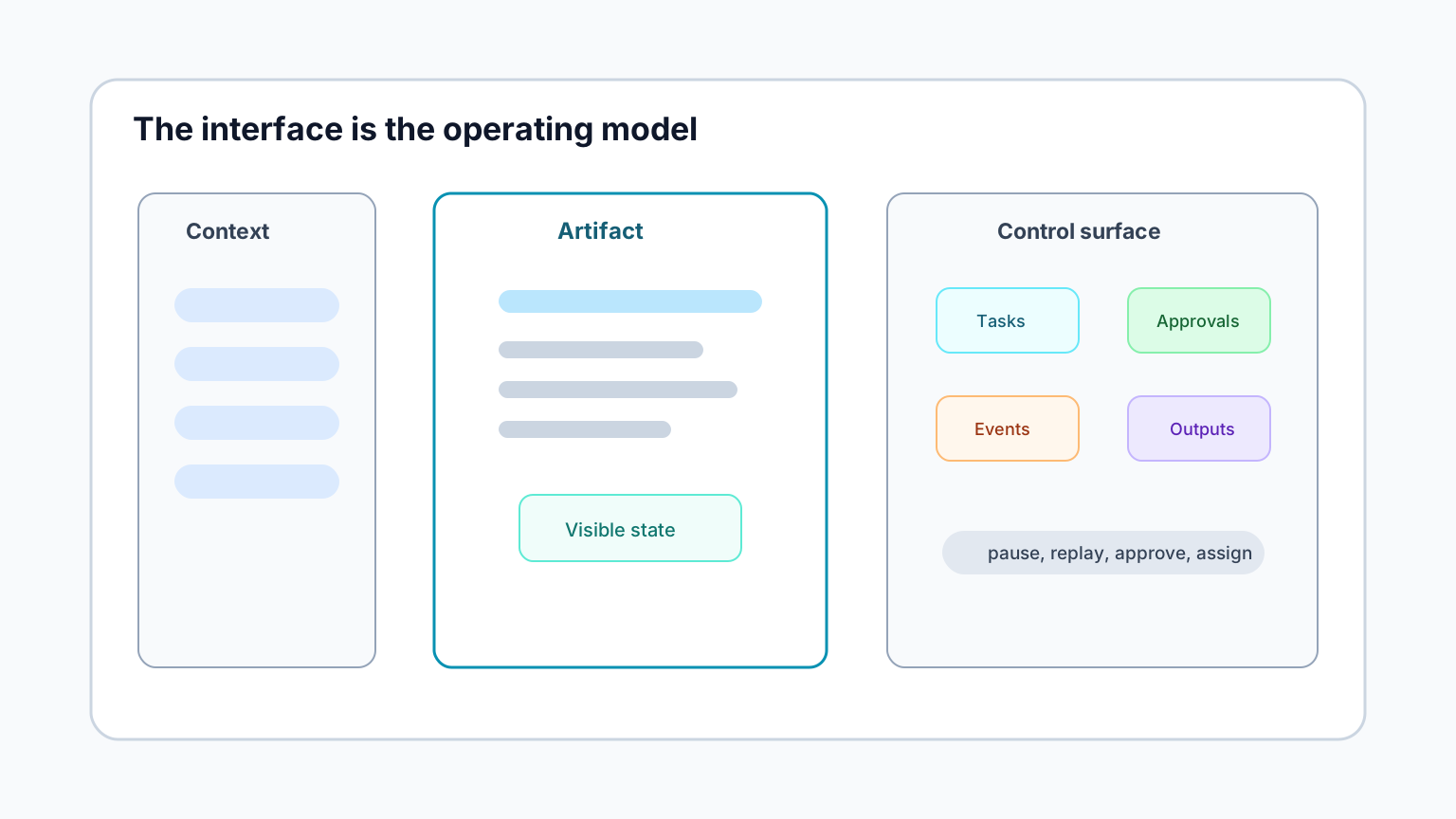
The interface has to become the operating model for how AI work moves through a company.
That means it needs to combine several surfaces that are usually separate today:
- The artifact surface, where the actual work product lives.
- The context surface, where sources, constraints, policies, and business truth are attached.
- The collaborator surface, where humans and agents have visible roles.
- The task surface, where work is assigned, queued, paused, resumed, and completed.
- The approval surface, where judgment and accountability happen.
- The event surface, where the system records what happened.
- The output surface, where derivative artifacts are produced and governed.
This is why I think the AI pointer article is best read as a signpost, not a destination.
Google is right about three things:
- AI should meet users across the tools they use.
- Users should not have to write long prompts to tell the model what the screen already shows.
- "This" and "that" are powerful interaction primitives.
But the future does not stop at better invocation.
The deeper shift is from single-player AI assistance to multiplayer AI work.
In that world, the interface does four jobs at once:
- It lets people and agents act on the work directly.
- It makes the artifact the durable center of collaboration.
- It preserves enough context and provenance for trust.
- It turns one piece of work into many governed outputs.
That is the end-to-end experience the pointer only begins to suggest.
The next AI interface is not the cursor.
The next AI interface is the shared workspace where humans and agents create, review, transform, and remember work together.
Interactive · Ask this article
Every essay here answers for itself.